Advertisements
Advertisements
Question
Complete the following table which relates to the homologous series of hydrocarbons.
| General formula | IUPAC name of the homologous series | Characteristic bond type | IUPAC name of the first member of the series |
| CnH2n−2 | (A) ______ | (B) ______ | (C) ______ |
| CnH2n+2 | (B) ______ | (E) ______ | (F) ______ |
Advertisements
Solution
| General formulaе | IUPAC name of the homologous series | Characteristic bond type | IUPAC name of the first member of the series |
| CnH2n−2 | (A) Alkyne | (B) Carbon-carbon triple bond | (C) Ethyne |
| CnH2n+2 | (B) Alkyl group | (E) Carbon-carbon single bond | (F) Methyl group |
RELATED QUESTIONS
What is a homologous series?
Write the molecular formula of first two members of homologous series having functional group −Br.
Write the molecular formula of the third member of the homologous series of carbon compounds with general formula CnН2n+1OН.
Propane and ethane are ______.
Succeeding members of a homologous series differ by ______.
 .
.
Haloalkanes react with alkalies to produce alcohol. Give the equation for the preparation of the second member of the homologous series of alcohol. State under what condition the reaction occurs.
The general formula of Alkane is _________________
There are different general molecular formula for all members of the homologous series.
Observe the structural formula and answer the following questions.
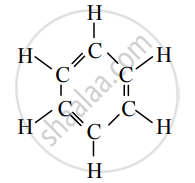
- Write the name of the given hydrocarbon.
- The given hydrocarbon is included in which type of hydrocarbon?
- What is the kind of compounds with the above characteristic structure called?
