Advertisements
Advertisements
Question
Observe the structural formula and answer the following questions.
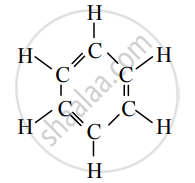
- Write the name of the given hydrocarbon.
- The given hydrocarbon is included in which type of hydrocarbon?
- What is the kind of compounds with the above characteristic structure called?
Advertisements
Solution
- The given hydrocarbon is benzene.
- The given hydrocarbon is included in cyclic hydrocarbon.
- The compounds having this characteristic unit in their structure are called aromatic compounds.
APPEARS IN
RELATED QUESTIONS
What is a homologous series?
Write the next homologue of the following: C2H4
What is meant by homologous series of carbon compounds?
Classify the following carbon compounds into two homologous series and name them.
C3H4, C3H6, C4H6, C4H8, C5H8, C5H10
The following vegetables are kept in a basket :
Potato, Tomato, Radish, Brinjal, Carrot, Bottle-gourd
Which two of these vegetables correctly represent the homologous structures?
(A) Carrot and Tomato
(B) Potato and Brinjal
(C) Radish and Carrot
(D) Radish and Bottle-gourd
What is the difference between two consecutive homologues:
(i) in terms of molecular mass?
(ii) in terms of number and kind of atoms per molecule?
By how many carbon atoms and hydrogen atoms do any two adjacent homologues differ?
Give the dot diagram of the first member of the alcohol.
 .
.
Write the name and molecular formula of the first member of the homologous series of alkynes.
Define homologous series of organic compounds. List its two characteristics. Write the name and formula of the first member of the series of alkenes.
Give three points to differentiate between saturated and unsaturated
hydrocarbons.
What is the difference in the molecular formula of any two adjacent homologues:
(i) In terms of molecular mass
(ii) In terms of number and kind of atoms per molecule?
Complete the correlation:
Alkene : C = C :: Alkyne: _______.
Cyclohexane : Cyclic hydrocarbon : : Isobutylene : _______
Find the odd one out and give its explanation.
Complete the following chart by using examples given in brackets.
(isobutylene, cyclohexane, propane, cyclohexene, cyclopentane, benzene, propyne, isobutane, propene)
| Straight chain hydrocarbons | Branched chain hydrocarbons | Cyclic hydrocarbons |
Which of the following does not belong to the same homologous series?
