Advertisements
Online Mock Tests
Chapters
2: Chemical Bonding
3: Acids, Bases and Salts
4: Analytical Chemistry
5: Mole Concept and Stoichiometry
6: Electrolysis
7: Metallurgy
8: Study of Compounds: Hydrogen Chloride
▶ 9: Study of Compounds: Ammonia
10: Study of Compounds: Nitric Acid
11: Study of Compounds: Sulphuric Acid
12: Organic Chemistry
13: Practical Work
![Lakhmir Singh solutions for Chemistry [English] Class 10 ICSE chapter 9 - Study of Compounds: Ammonia - Shaalaa.com](/images/chemistry-english-class-10-icse_6:b9d33ffc3c864725b49a398fa5334703.jpg "Lakhmir Singh solutions for Chemistry [English] Class 10 ICSE chapter 9 - Study of Compounds: Ammonia")
Advertisements
Solutions for Chapter 9: Study of Compounds: Ammonia
Below listed, you can find solutions for Chapter 9 of CISCE Lakhmir Singh for Chemistry [English] Class 10 ICSE.
Lakhmir Singh solutions for Chemistry [English] Class 10 ICSE 9 Study of Compounds: Ammonia Intext Question [Pages 181 - 189]
TEST YOUR UNDERSTANDING - 1
State whether the following statement is True or False.
Ammonia is highly soluble in water.
State whether the following statement is True or False.
The molecular formula of ammonia is NH2.
State whether the following statement is True or False.
In ammonia, the nitrogen atom has a lone pair of electrons.
State whether the following statement is True or False.
Ammonia can be liquefied at high pressure.
Fill in the following blanks with suitable words.
When excess of ammonia is treated with chlorine, the gas evolved is ______.
Calcium hydroxide when reacts with ammonium chloride, gas evolved is ______.
2NH3 + H2SO4 → ______
Choose the correct option for each of the following questions.
The chemical formula of muriatic acid is ______.
H2SO4
HNO3
HF
HCl
Ammonia is dried over which of the following compounds?
Slaked lime
Quick lime
CaCl2
PCl5
Among the following compounds, which one does not give ammonia with water?
Mg3N2
AlN
CaN2
Ca(CN)2
Give reasons for the statement.
Compounds of ammonia do not occur as minerals.
Give reasons:
Ammonium nitrate is not used in the preparation of ammonia.
Give reasons:
Conc. H2SO4 is a good drying agent, yet it is not used to dry NH3.
A substance ‘A’ was heated with slaked lime and a gas ‘B’ with the pungent smell was obtained. Name the substances A and B and give a balanced equation.
Write a balanced chemical equation for the following:
Laboratory preparation of ammonia from ammonium chloride.
How is ammonia dried and collected in the laboratory?
TEST YOUR UNDERSTANDING - 2
State whether the following statement is True or False.
Ammonium sulphate salt on heating gives rise to ammonia.
State whether the following statement is True or False.
Ammonia gas is collected by downward displacement of air.
State whether the following statement is True or False.
Ammonia gas can be prepared by metal nitrides.
State whether the following statement is True or False.
Preparation of ammonia by Haber process is an endothermic process.
Fill in the following blanks with suitable words.
Ammonia and ammonium compounds do not occur as minerals because they are highly ______.
On heating, ammonium sulphate salt with sodium hydroxide the gas evolved is ______.
When ammonia reacts with sulphuric acid, the product formed is ______.
NH4NO2 on heating gives _______ and water.
Choose the correct option for each of the following questions.
Ammonia was initially called ______.
nitro
alkaline air
muriatic base
marsh gas
Which scientist studied the chemical composition of ammonia in 1785?
Priestly
Davy
Claude Berthollet
Cavendish
An aqueous solution of ammonia NH3 is called ______.
Ammonium hydroxide
Ammonium sulphide
Ammonium oxide
Ammonium nitride
What is the molecular weight of ammonia?
17
18
17.5
20
What are the boiling and melting points of ammonia, respectively?
−33.5°C and −77.7°C
−77.7°C and −33.4°C
−10.6°C and −20.3°C
−32.4°C and −77.7°C
Give reasons for the following:
Aqueous solution of ammonia is used for removing grease stains from woollen clothes.
How can ammonia be decomposed forming nitrogen and hydrogen?
Describe the industrial preparation method of ammonia, with a labelled diagram.
Explain why and how chlorofluorocarbons are responsible for the depletion of the ozone layer?
Explain the purpose of the fountain experiment with a labelled diagram.
ART EXPRESS
As we studied that chlorofluorocarbons are harmful to the environment, as they deplete the ozone layer. Nowadays CFCs are being replaced by HCFCs, which are comparatively less harmful towards the environment. Make a PowerPoint Presentation about the timeline of discovery and usage of various refrigerants starting from ammonia. Discuss the beneficial and harmful effects (if any) of using these refrigerants and why the new refrigerants replaced the old ones in a wide range of applications.
Lakhmir Singh solutions for Chemistry [English] Class 10 ICSE 9 Study of Compounds: Ammonia EXERCISE [Pages 192 - 194]
Objective Questions
True or False.
In an exothermic reaction, heat is evolved.
True or False.
To get dry ammonia, the gas is passed through conc. H2SO4.
True or False.
Ammonia gas is heavier than air.
True or False.
Ammonia gas being soluble in water, it is not collected over water.
True or False.
The possibility of back suction is due to the high solubility of ammonia.
Fill in the Blanks
NH4NO3 \[\ce{->[\Delta]}\] ______ + 2H2O
Mg3N2 + 6H2O → 3Mg(OH)2 + ______↑
The rate of conversion of reacting gases into ammonia by Haber's process is ______.
Ammonia gas condenses easily because the boiling point of ammonia is ______ as compared to N2 and Н2.
Ammonia gas is ______ soluble in water as compared to N2 and O2.
Formation of ammonia requires ______ temperature.
Four volumes of reactants produce ______ volumes of ammonia.
A promoter is used to ______ the efficiency of the catalyst.
Multiple Choice Questions
Aqueous solution of ammonia consists of ______.
H+
only ОH−
only \[\ce{NH^+4}\]
\[\ce{NH^+4}\] and ОH−
A basic hydride of nitrogen is ______.
NH3
N2H4
N2H2
N3H
On passing ammonia over heated copper oxide, the gas evolved is ______.
oxygen
ammonia
nitrogen
nitric oxide
When ammonia is passed through Nessler's solution the precipitate obtained is ______.
brown in colour
blue in colour
orange in colour
yellow in colour
Ammonia can be collected by ______.
upward displacement of water
upward displacement of air
downward displacement of water
downward displacement of air
The catalyst used in the Haber's process for the manufacture of ammonia is ______.
Pt
Fe
Mo
Al2O3
Ammonia can be obtained by adding water to ______.
Ammonium chloride
Ammonium nitrite
Magnesium nitride
Magnesium nitrate
Match the column I with column II and write the correct answer.
| Column I | Column II |
| (p) Ammonia | (i) Haber Process |
| (q) Solubility | (ii) Fountain experiment |
| (r) On oxidation, ammonia produces | (iii) Nitric oxide |
| (s) Ammonia reacts with HNO3 | (iv) Ammonium nitrate |
(p) - (i), (q) - (ii), (r) - (iii), (s) - (iv)
(p) - (ii), (q) - (i), (r) - (iii), (s) - (iv)
(p) - (iii), (q) - (i), (r) - (iv), (s) - (ii)
(p) - (iv), (q) - (i), (r) - (iii), (s) - (ii)
An aqueous solution of ammonia is ______.
neutral
acidic
basic
amphoteric
Descriptive Questions Short Answer Questions
Explain why ammonia is considered as a lewis base?
Give reason why ammonia is good refrigerant?
Write a balanced equation for a reaction in which ammonia is oxidized by:
A metal oxide
Write a balanced chemical equation for a reaction in which ammonia is oxidised by the following:
A gas which is not oxygen.
A gas ‘P’ gives dense white fumes with chlorine. Its aqueous solution gives a blue colour with copper (II) hydroxide.
- Name the gas P.
- Give its formula.
- Give three uses of P.
Ammonia solution in water gives a blue precipitate when it combines with a solution of copper salt. The blue precipitate further dissolves in excess of an ammonia solution to give the azure blue solution. Explain with the equation.
Give the chemical equation(s) to prove that NH3 contains nitrogen and hydrogen.
Write the equation for the reaction:
Aluminium nitride and Water.
By taking the example of metal oxide, explain the reducing nature of ammonia. Give the chemical equation for the reaction.
Answer the following.
What is the action of chlorine on Excess NH3.
How do you explain that ammonia is not a supporter of combustion and contains nitrogen and hydrogen?
What do understand by catalytic oxidation? Explain it with an example.
How will you test ammonia gas?
How will you test ammonium ion?
Explain with a diagram the preparation of aqueous ammonia.
- Of the two gases, ammonia and hydrogen chloride, which is more denser? Name the method of collection of this gas.
- Give one example of a reaction between the above two gases which produces a solid compound.
Copy and complete the following table relating to important industrial process:
| Name of the process | Temperature | Catalyst | Equation for the catalyzed reaction |
| Haber’s Process |
Give a balanced chemical equation for the following:
Lab. preparation of ammonia using an ammonium salt.
Give a balanced chemical equation for the following:
Reaction of ammonia with excess of chlorine.
Give a balanced chemical equation for the following:
Reaction of ammonia with sulphuric acid.
The diagram shows a simple arrangement of the fountain experiment:
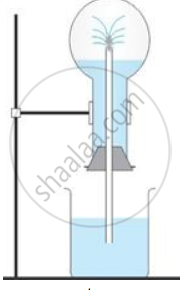
(i) Name the two gases you have studied which can be used in this experiment
(ii) What is the common properly demonstrated by this experiment
Name the gas evolved when the following mixtures are heated.
Calcium hydroxide and ammonium chloride.
Name the gas evolved when the following mixtures are heated.
Sodium nitrite and ammonium chloride.
Write a balanced chemical equation for the following:
When an excess of ammonia is treated with chlorine.
Write a balanced chemical equation for the following:
An equation to illustrate the reducing nature of ammonia.
Write the balanced chemical equation to prepare ammonia gas in the laboratory by using an alkali.
State why concentrated sulphuric acid is not used for drying ammonia gas.
Why is ammonia gas not collected over water?
Study the flow chart given and give balanced equations to represent the reactions A, B and C:
\[\ce{Mg3N2 ->[A] NH3 <=>[B][C] NH4Cl}\]
Long Answer Questions
Name the substance used for drying ammonia.
Write an equation to illustrate the reducing nature of ammonia.
With reference to Haber's process for the preparation of ammonia, write the equation and the conditions required.
The questions below are related to the manufacture of ammonia.
- Name the process.
- In what ratio must the reactants be taken?
- Name the catalyst used.
- Give the equation for the manufacture of ammonia.
- Ammonia can act as a reducing agent; write a relevant equation for such a reaction.
The diagram shows an experimental set up for the laboratory preparation of a pungent smelling gas. The gas is alkaline in nature.
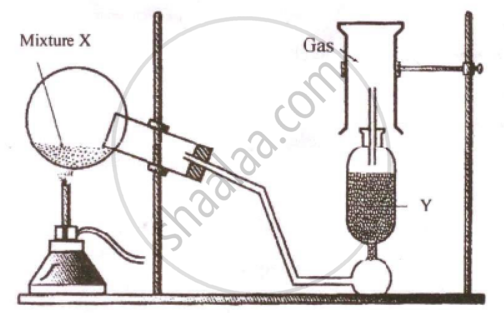
- Nature the gas collected in the jar.
- Write the balance equation for the above preparation.
- How is the gas being collected?
- Name the drying agent used.
- How will you find that the jar is full of gas?
Explain the following:
Ammonium nitrate is not used in the laboratory preparation of NH3.
State a relevant reason for the following:
Ammonia gas is not collected over water.
Solutions for 9: Study of Compounds: Ammonia
Lakhmir Singh solutions for Chemistry [English] Class 10 ICSE chapter 9 - Study of Compounds: Ammonia
Shaalaa.com has the CISCE Mathematics Chemistry [English] Class 10 ICSE CISCE solutions in a manner that help students grasp basic concepts better and faster. The detailed, step-by-step solutions will help you understand the concepts better and clarify any confusion. Lakhmir Singh solutions for Mathematics Chemistry [English] Class 10 ICSE CISCE 9 (Study of Compounds: Ammonia) include all questions with answers and detailed explanations. This will clear students' doubts about questions and improve their application skills while preparing for board exams.
Further, we at Shaalaa.com provide such solutions so students can prepare for written exams. Lakhmir Singh textbook solutions can be a core help for self-study and provide excellent self-help guidance for students.
Concepts covered in Chemistry [English] Class 10 ICSE chapter 9 Study of Compounds: Ammonia are .
Using Lakhmir Singh Chemistry [English] Class 10 ICSE solutions Study of Compounds: Ammonia exercise by students is an easy way to prepare for the exams, as they involve solutions arranged chapter-wise and also page-wise. The questions involved in Lakhmir Singh Solutions are essential questions that can be asked in the final exam. Maximum CISCE Chemistry [English] Class 10 ICSE students prefer Lakhmir Singh Textbook Solutions to score more in exams.
Get the free view of Chapter 9, Study of Compounds: Ammonia Chemistry [English] Class 10 ICSE additional questions for Mathematics Chemistry [English] Class 10 ICSE CISCE, and you can use Shaalaa.com to keep it handy for your exam preparation.
