Advertisements
Online Mock Tests
Chapters
▶ 2: Chemical Bonding
3: Acids, Bases and Salts
4: Analytical Chemistry
5: Mole Concept and Stoichiometry
6: Electrolysis
7: Metallurgy
8: Study of Compounds: Hydrogen Chloride
9: Study of Compounds: Ammonia
10: Study of Compounds: Nitric Acid
11: Study of Compounds: Sulphuric Acid
12: Organic Chemistry
13: Practical Work
![Lakhmir Singh solutions for Chemistry [English] Class 10 ICSE chapter 2 - Chemical Bonding - Shaalaa.com](/images/chemistry-english-class-10-icse_6:b9d33ffc3c864725b49a398fa5334703.jpg "Lakhmir Singh solutions for Chemistry [English] Class 10 ICSE chapter 2 - Chemical Bonding")
Advertisements
Solutions for Chapter 2: Chemical Bonding
Below listed, you can find solutions for Chapter 2 of CISCE Lakhmir Singh for Chemistry [English] Class 10 ICSE.
Lakhmir Singh solutions for Chemistry [English] Class 10 ICSE 2 Chemical Bonding Intext Question [Pages 28 - 39]
TEST YOUR UNDERSTANDING - 1
State whether the following statement is True or False.
In order to attain a stable configuration, magnesium loses its 2 valence electrons.
State whether the following statement is True or False.
Ionic nature of a compound is related inversely to the electronegativity difference between two atoms.
State whether the following statement is True or False.
Elements of group VA and VIA easily lose their valence electrons.
State whether the following statement is True or False.
Ionic bonds are non-directional.
Fill in the following blanks with suitable words.
______ of electrons is involved in the formation of an electrovalent bond.
Atoms of group ______ and ______ can easily lose their valence electron.
The chemical bond between magnesium and oxygen in magnesium oxide is ______ in nature.
During the formation of magnesium chloride, one magnesium ion forms ionic bonds with ______ ions.
Choose the correct option for each of the following questions.
When an atom loses electron(s) ______.
cation is formed
anion is formed
both cation and anion are formed
none
Bonds formed between metals and non-metals are ______.
electrovalent
covalent
coordinate
Both electrovalent and covalent
Ionic compounds have ______.
high electronegativity difference
low ionisation potential
low electron affinity
High electronegativity difference and low ionisation potential
What do you understand by a chemical bond?
Give the Lewis symbol for an oxygen atom.
How is an ion formed?
Give two examples of ionic compounds.
Which kind of force is present between atoms of an ionic bond?
Explain the characteristics of ionic compounds.
What are electron dot symbols?
Why are ionic compounds stable?
What are the three methods through which an atom can attain a stable electronic configuration?
How is sodium chloride formed? Explain using its electron dot structure.
Write the three necessary conditions required for the formation of an electrovalent compound.
Explain the formation of calcium oxide through its orbit structure.
TEST YOUR UNDERSTANDING - 2
State whether the following statement is True or False.
The covalency of nitrogen is 3.
State whether the following statement is True or False.
Chlorine molecule and CCl4 are non-polar compounds.
State whether the following statement is True or False.
Covalent bonds do not break on heating.
State whether the following statement is True or False.
NH3 has 2 lone pairs of electrons.
State whether the following statement is True or False.
In polar molecule, electrons lie closer to the more electropositive element.
Fill in the following blanks with suitable answers.
In a water molecule oxygen has a partial ______ charge.
Covalent compounds have ______ melting points.
A covalent bond is formed through ______ of valence electrons.
Choose the correct option for each of the following questions.
Which of the following sets of elements will form covalent compound?
Na and Cl
Mg and O
He and Ne
F and O
A covalent bond in which electrons are not shared equally is ______.
polar
non-polar
single bond
double bond
Which of the following properties is not shown by an electrovalent compound?
Slow reaction
Water soluble
Non-volatile
Hard solids
What are the constituent particles of covalent compounds?
What is a double bond and how is it represented?
How many types of covalent bonds are there?
Why is water termed as a polar molecule?
What are the conditions necessary for the formation of covalent molecules?
How is bonding different in a covalent bond as compared to ionic bond?
How is a chlorine molecule formed?
State differences between the properties of ionic compounds and covalent compounds.
Give two examples of compounds which are covalent when taken pure but form ions on dissolving in water. Write the formula of ions formed in the aqueous solution.
Give two examples of non-polar compounds and explain their bond formation.
TEST YOUR UNDERSTANDING - 3
State whether the following statement is True or False.
The ammonia molecule has one coordinate bond.
State whether the following statement is True or False.
Both hydronium ion and hydroxide ion are formed by water molecules.
State whether the following statement is True or False.
During the formation of ammonium ion hydrogen ion donates its lone pair to ammonia.
State whether the following statement is True or False.
Oxygen has 2 lone pairs of electrons.
Fill in the following blanks with suitable answers.
Fill in the blank
Coordinate bond is also called __________bond.
______ and ______ ions are formed on ionisation of a water molecule.
In the hydronium ion the arrow of the coordinate bond is from ______ atom to ______ atom.
Choose the correct option for each of the following questions.
A coordinate bond has properties of:
ionic bond
covalent bond
both ionic and covalent bonds
hydrogen bond
After removing the H+ ion from the water molecule:
OH− is formed.
OH is formed.
\[\ce{^\bullet OH}\] is formed.
Both OH− and \[\ce{^\bullet OH}\] are formed.
The donor atom in ammonia is ______.
nitrogen
hydrogen
oxygen
None of these
Which of the following is the appropriate representation of a coordinate bond?
→
---
⇒
–
Ammonium ion contains ______.
1 covalent and 4 coordination bonds
3 covalent and 1 coordination bonds
2 covalent and 2 coordination bonds
4 covalent and 1 coordination bonds
What is the significance of the arrow in a coordinate bond?
What is the reason for the polarisation of O–H bond in water molecule?
What is the basic difference between covalent and coordinate bond formation?
Give the conditions for coordinate bond formation.
Explain the formation of the ammonium ion.
Explain the formation of hydronium ion.
Write a short note on self-ionisation of water.
ART EXPRESS
Make a model showing the formation of any ionic or covalent molecule using wire and beads. Use different colours of beads to differentiate between the electrons of the two elements. Put the beads in the wire and give them a circular shape to show orbits. Put all of this together on a cardboard representing the formation of the molecule.
Lakhmir Singh solutions for Chemistry [English] Class 10 ICSE 2 Chemical Bonding EXERCISE [Pages 41 - 44]
Objective Questions
True or False.
Covalent bonds are directional.
True or False.
Hydrogen fluoride is an ionic compound.
True or False.
Formation of an ionic bond requires one of the combining atoms to have low ionisation potential.
True or False.
Non-polar covalent molecules are also called as dipole molecules.
True or False.
Caesium is the most electropositive element.
Fill in the Blanks
A bond formed by sharing a pair of electrons, provided entirely by one of the combining atoms is a/an ______.
The ratio of magnesium to chloride ion in magnesium chloride is ______ is to ______.
Complete the following equation:
HCl + H2O → ______ + Cl−
Ethene has one ______ covalent bonds and ______ single covalent bonds.
Non-polar covalent molecules are soluble in ______ solvents.
Multiple Choice Questions
An ionic compound is a good conductor of electricity in an aqueous state because ______.
ions are not free
molecules are not free
molecules become free
bond strength decreases
Which of the following compounds does not ionise and dissociate in water?
HCl
NaOН
KNO3
CCl4
Which of the following compounds contains one lone pair?
Methane
Ammonia
Water
Hydronium ion
Which type of bonding is present in hydrogen chloride?
Ionic
Metallic
Covalent
Coordinate
Which of the following bonds is present in carbon tetrachloride?
Double covalent bond
Ionic bond
Triple covalent bond
Single covalent bond
What is the type of bonding present in nitrogen?
Double covalent bond
Single covalent bond
Polar covalent bond
Triple covalent bond
What are the particles that attract one another to form electrovalent compounds called?
Protons
Ions
Electrons
Neutrons
Which of the following is not a common characteristic of electrovalent compound?
High melting point
Good conductor in molten state
Contains oppositely charged ions
Insoluble in water
Which of the following contains ionic, covalent as well as coordinate bond?
NaCl
CCl4
NH4Cl
NH3
Compound ‘A’ consists of only molecules. ‘A’ will have:
crystalline hard structure
low melting and boiling point
electrovalent bond
strong force of attraction among its molecules.
State which of the following is a common characteristic of a covalent compound.
High melting point
Constituents are molecules
Solubility in water
Conducts electricity in an aqueous state.
A compound with low boiling point is ______.
Sodium chloride
Magnesium chloride
Calcium oxide
Carbon tetrachloride
Match column I with column II.
| Column I | Column II |
| (p) Cl | (i) anion |
| (q) Cl− | (ii) silver white |
| (r) Na | (iii) cation |
| (s) Na+ | (iv) yellow-green |
(p) - (i), (q) - (iv), (r) - (iii), (s) - (ii)
(p) - (iv), (q) - (i), (r) - (ii), (s) - (iii)
(p) - (iii), (q) - (ii), (r) - (i), (s) - (iv)
(p) - (i), (q) - (iii), (r) - (ii), (s) - (iv)
Match column I with column II.
| Column I | Column II |
| (p) CCl4 | (i) Ionic |
| (q) \[\ce{NH^+4}\] | (ii) Coordination |
| (r) NaCl | (iii) Covalent |
(p) - (iii), (q) - (ii), (r) - (i)
(p) - (ii), (q) - (i), (r) - (iii)
(p) - (ii), (q) - (iii), (r) - (i)
(p) - (i), (q) - (iii), (r) - (ii)
Match column I and column II.
| Column I | Column II |
| (p) Most electropositive | (i) Magnesium |
| (q) Polar molecule | (ii) Caesium |
| (r) Divalent | (iii) Ammonia |
(p) - (ii), (q) - (iii), (r) - (i)
(p) - (i), (q) - (ii), (r) - (iii)
(p) - (iii), (q) – (ii), (r) – (i)
(p) - (i), (q) - (iii), (r) - (ii)
Solid sodium chloride does not conduct electricity as ______.
the strength of the bond is weak
it contains free ions
it does not contain any free ions
it contains free ions as well as molecules
Which of the following compounds neither dissociate nor ionise in water?
Hydrochloric acid
Sodium hydroxide
Potassium nitrate
Carbon tetrachloride
The table shows the electronic configuration of four elements.
| Element | Electronic configuration |
| W | 2, 6 |
| X | 2, 8 |
| Y | 2, 8, 1 |
| Z | 2, 8, 7 |
Which pair of atoms will form a covalent compound?
two atoms of W
two atoms of X
an atom of W and an atom of X
an atom of Y and an atom of Z
Which of the following has two sets of lone pair of electrons in them?
Ammonia
Methane
Water
Ammonium ion
Which electron arrangement for the outer shell electrons in a covalent compound is correct?


The type of bonding present in hydrogen chloride is ______.
metallic
ionic
covalent
coordinate
Descriptive Questions Short Answer Questions
State the force which holds two or more atoms together as a stable molecule.
By drawing an electron dot diagram, show the lone pair effect leading to the formation of the ammonium ion from ammonia gas and hydrogen ion.
Give a reason as to why hydrogen chloride can be termed as a polar covalent compound.
Why do covalent compounds exist as gases, liquids or soft solids?
What is meant by a chemical bond?
What is meant by the term chemical bonding?
Draw the structure for carbon tetrachloride and explain the type of bonding present.
Explain the bonding in methane molecule using electron dot structure.
Why is carbon tetrachloride, which is a liquid, a non-electrolyte?
There are three elements X, Y and Z with atomic numbers 19, 8 and 17, respectively. What is the molecular formula of the compound formed between X and Z and give the type of chemical bond in the final compound?
State the type of compounds formed by the transfer of valence electrons from one atom to another and explain the method of their formation. What is the role of ‘cations’ and ‘anions’ in their formation?
What is meant by the term ‘electrovalency’?
Explain why Na (atomic number 11) has an electro-positive valency of +1.
Explain why Cl (atomic number 17) has an electro-negative valency of −1.
State three differences between ‘X’ and ‘X+’.
What is a lone pair of electrons?
Draw an electron dot diagram of a hydronium ion and label the lone pair of electrons.
Name a neutral covalent molecule which contains one lone pair of electrons.
Differentiate between the electrical conductivity of copper sulphate solution and copper metal.
Draw an electron dot diagram for the formation of the following. State the type of bonding present in them.
Hydroxyl ion
Compare the compounds carbon tetrachloride and sodium chloride with regard to solubility in water and electrical conductivity.
An element L consists of molecules.
What type of bonding is present in the particles that make up L?
An element L consists of molecules.
When L is heated with iron metal, it forms a compound, FeL. What chemical term would you use to describe the change undergone by L?
By drawing an electron dot diagram show the formation of Ammonium ion [Atomic No.: N = 7 and H = 1]
State the type of bonding in the following molecule.
Water
State the type of Bonding in the following molecule:
Calcium oxide
What do you understand by lone pair of electrons ?
Draw the electron dot diagram of hydronium ion. (H = 1; O = 8)
Draw the electron dot structure of :
Nitrogen molecule [N = 7]
Draw the electron dot structure of :
Sodium chloride [Na = 11, Cl = 17]
Draw the electron dot structure for the following:
Ammonium ion
[At. no.: N = 7, H = 1]
Draw the electron dot diagram for the compound given below. Represent the electrons by (.) and (x) in the diagram.
[Atomic No.: Ca = 20, O = 8]
Calcium oxide
Draw the electron dot diagram for the compound given below. Represent the electrons by (.) and (x) in the diagram.
[Atomic No.: Cl = 17]
Chlorine molecule
Draw the electron dot diagram for the compound given below. Represent the electrons by (.) and (x) in the diagram.
[Atomic No.: O = 8, H = 11]
Water molecule
Long Answer Questions
Elements A, B, C and D have electronic configurations:
A = 2, 8, 1
B = 2, 8, 7
C = 2, 5
D = 1
- What type of bond is formed between:
- A and B
- C and D
- What is the formula of the compound formed between:
- B and D
- A and B
Draw the electron dot structure of the covalent compound methane (non polar) and HCl (polar) and give two difference between them.
Give reasons for the following:
Electrovalent compounds are good conductor of electricity.
Give reasons for the following:
Electrovalent compounds are generally hard crystals.
Give reasons for the following:
Non-polar covalent compounds do not conduct electricity.
Give reasons for the following:
The rate of reaction is fast for electrovalent compounds.
Give the reasons for chemical bonding between two atoms.
Explain how ‘duplet and octet’ rules are involved for an atom to achieve stable electronic configuration.
Name the charged particles which attract one another to form electrovalent compound?
In the formation of electrovalent compounds, electrons are transferred from one element to another. How are electrons involved in the formation of a covalent compound?
The electronic configuration of nitrogen is (2, 5). How many electrons in the outer shell of a nitrogen atom are not involved in the formation of a nitrogen molecule?
In the formation of magnesium chloride (by direct combination between magnesium and chloride), name the substance that is oxidized and the substance that is reduced.
There are three elements E, F, G with atomic numbers 19, 8 and 17 respectively.
Classify the above elements as metals and non-metals.
There are three elements E, F, G with atomic numbers 19, 8 and 17 respectively. Give the molecular formula of the compound formed between E and G.
There are three elements E, F, G with atomic numbers 19, 8 and 17 respectively. State the type of chemical bond in this compound.
Draw an electron dot diagram to show the formation of the following compound.
Methane
[H = 1, C = 6]
Draw an electron dot diagram to show the formation of the following compound.
Magnesium chloride
[Mg = 12, Cl = 17]
Study the extract of the Periodic Table given below and answer the questions that follow. Give the alphabet corresponding to the element in question.
DO NOT repeat an element.
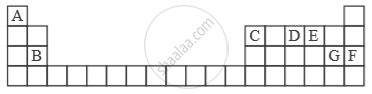
- Which element forms electrovalent compound with G?
- The ion of which element will migrate towards the cathode during electrolysis?
- Which non-metallic element has the valency of 2?
- Which is an inert gas?
Solutions for 2: Chemical Bonding
Lakhmir Singh solutions for Chemistry [English] Class 10 ICSE chapter 2 - Chemical Bonding
Shaalaa.com has the CISCE Mathematics Chemistry [English] Class 10 ICSE CISCE solutions in a manner that help students grasp basic concepts better and faster. The detailed, step-by-step solutions will help you understand the concepts better and clarify any confusion. Lakhmir Singh solutions for Mathematics Chemistry [English] Class 10 ICSE CISCE 2 (Chemical Bonding) include all questions with answers and detailed explanations. This will clear students' doubts about questions and improve their application skills while preparing for board exams.
Further, we at Shaalaa.com provide such solutions so students can prepare for written exams. Lakhmir Singh textbook solutions can be a core help for self-study and provide excellent self-help guidance for students.
Concepts covered in Chemistry [English] Class 10 ICSE chapter 2 Chemical Bonding are .
Using Lakhmir Singh Chemistry [English] Class 10 ICSE solutions Chemical Bonding exercise by students is an easy way to prepare for the exams, as they involve solutions arranged chapter-wise and also page-wise. The questions involved in Lakhmir Singh Solutions are essential questions that can be asked in the final exam. Maximum CISCE Chemistry [English] Class 10 ICSE students prefer Lakhmir Singh Textbook Solutions to score more in exams.
Get the free view of Chapter 2, Chemical Bonding Chemistry [English] Class 10 ICSE additional questions for Mathematics Chemistry [English] Class 10 ICSE CISCE, and you can use Shaalaa.com to keep it handy for your exam preparation.
