Advertisements
Online Mock Tests
Chapters
2: Fundamentals of Genetics
3: Absorption by Roots
▶ 4: Transpiration
5: Photosynthesis
6: The Circulatory System
7: The Excretory System
8: The Nervous System and Sense Organs
9: The Endocrine System
10: The Reproductive System
11: Human Population
12: Physical Health and Hygiene
13: Pollution
![ICSE solutions for Biology [English] Class 10 ICSE chapter 4 - Transpiration - Shaalaa.com](/images/biology-english-class-10-icse_6:5f2b1b2038084cf381bfa42c826a928c.jpg "ICSE solutions for Biology [English] Class 10 ICSE chapter 4 - Transpiration")
Advertisements
Solutions for Chapter 4: Transpiration
Below listed, you can find solutions for Chapter 4 of CISCE ICSE for Biology [English] Class 10 ICSE.
ICSE solutions for Biology [English] Class 10 ICSE 4 Transpiration Short Questions
Define the following term:
Transpiration
Name the three types of transpiration.
What is meant by the term transpiration stream?
Where are stomata generally found?
State the functions of guard cells.
How do stomata differ from a lenticel?
What are lenticels? Where are they found?
Name the organ in which guard cells are located and mention the main functions of these.
Give the function of a thick cuticle layer in desert plants.
What is the advantage of wilting to a plant?
Briefly explain how the rate of transpiration is affected by:
The intensity of light.
Briefly explain how the rate of transpiration is affected by:
The humidity of the atmosphere.
Describe any three conditions which affect transpiration.
What are the advantages of transpiration to the plant?
What are the disadvantages of transpiration?
“A higher rate of transpiration is recorded on a windy day rather than on a calm day.” Explain.
Explain the relationship between transpiration through the aerial parts and absorption by the root hairs
Describe an experiment to prove that transpiration occurs more from the undersurface of dorsiventral leaves.
ICSE solutions for Biology [English] Class 10 ICSE 4 Transpiration Give Reasons
Give Reasons for the following:
Transplanting of seedlings to a flowerbed in the evening is better than doing so in the morning.
Give Reasons for the following:
Land plants die if their roots remain waterlogged.
Give Reasons for the following:
Young plants wilt on a hot sunny day.
Give Reasons for the following:
Plants absorb more water than their requirement
Give Reasons for the following:
Balsam plants wilt during midday even if the soil is well watered.
Give Reasons for the following:
Forest bring in the rain, transpiration is the cause.
Give Reasons for the following:
Why do some herbaceous plants show wilting of leaves during mid-day which again recover in the evening?
Give Reasons for the following:
Guard cells are small in size and are kidney-shaped in outline.
ICSE solutions for Biology [English] Class 10 ICSE 4 Transpiration Differentiate
Differentiate Between Transpiration and Guttation.
Differentiate Between Transpiration and Evaporation.
Distinguish between the following:
Stomata and lenticels
Differentiate Between Cuticular and Lenticular transpiration.
Differentiate Between Transpiration and Translocation.
Differentiate Between Transpiration and Perspiration.
Differentiate Between Stomata and Hydathodes.
Differentiate between guttation and bleeding in plants.
Differentiate Between Cobalt chloride paper and Goat’s bladder.
ICSE solutions for Biology [English] Class 10 ICSE 4 Transpiration Diagram Based Questions
The diagram below represents a structure found in a leaf.

Study the same and answer the questions that follow:
(i) Name the pis labeled A and B.
(ii) What is the biological term for the above structure?
(iii) What is the function of the part labeled A?
(iv) Mention two structural features of A, which help in the function mentioned in (iii) above.
(v) Where is this structure likely to be found in a leaf?
(vi) The above structure helps in the process of transpiration. Explain the term transpiration.
(vii) How many other cells are found surrounding this structure as seen in the diagram?
The figure below represents the vertical section of a leaf:

(i) Name the parts labeled 1 to 5.
(ii) What do the two arrows (dotted and solid) indicate in the day time and at night?
(iii) Could you add one more arrow in the figure? If yes, what for?
(iv) How many leaf veins have been shown in this section?
Given below are the diagrams of a certain structure in plants in two conditions.

(i) Name the structure shown.
(ii) Name the parts numbered 1-5.
(iii) What is the most apparent difference between A and B in the structure shown?
(iv) Describe the mechanism which brings about the change in the structure depicted in A and B.
Given below is an experimental set up to study a particular process:

(i) Name the process being studied.
(ii) Explain the process named in (i) above.
(iii) Why is the pot covered with a plastic sheet?
(iv) Mention one way in which this process is beneficial to the plant.
(v) Suggest a suitable control for this experiment.
The figure given below represents an experimental setup with a weighing machine to demonstrate a particular process in plants. The experimental set-up was placed in bright sunlight. Study the diagram and answer the following questions:
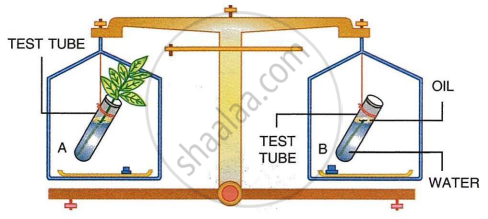
- Name the process intended for the study.
- Define the above mentioned process.
- When the weight of the test tubes (A and B) is taken before and after the experiment, what is observed? Give reasons to justify your observations in A & B.
- What is the purpose of keeping the test tube B in the experimental set-up?
- What is the purpose of putting oil in the test tube?
Study the diagram given alongside and answer the questions that follow:

(i) Explain the physiological process of being study.
(ii) What will be the observations in the two test-tubes after about 2-3 days?
(iii) Give a reason for your answer in (ii) above.
(iv) Why is the surface of water covered with oil?
(v) State the purpose of setting up test tube B.
Study the diagram given below and answer the questions that follow:
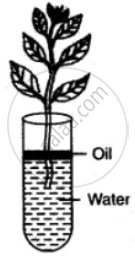
(i) Name the process being studied in the above experiment.
(ii) Explain the process mentioned in (i) above.
(iii) Why is oil placed over water?
Given below is the diagram of an experimental set up to study the process of transpiration in plants. Study the same and then answer the questions that follow:

(i) What is the colour of dry cobalt chloride paper?
(ii) Is the experimental leaf a monocot or a dicot? Give a reason to support your answer.
(iii) Why axe glass slides placed over the dry cobalt chloride papers?
(iv) After about half an hour what change, if any, would you expect to find in the cobalt chloride paper placed on the dorsal and ventral sides of the leaf? Give a reason to support your answer.
(v) Define the term ‘transpiration’.
The apparatus shown here is Girreau’s poto-meter designed to demonstrate unequal transpiration from the two surfaces of a dorsiventral leaf. Before keeping the leaf in between the cups, anhydrous calcium chloride (CaCl2) contained in two small vials were weighed and placed in both the cups. The ends of the cups were closed with corks through which two mercury manometers were connected. After a few hours, CaCl2 vials were taken out and weighed again.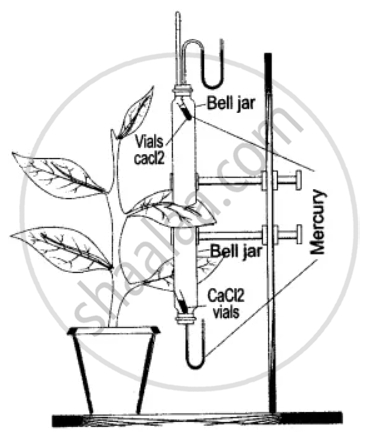
(i) What is the purpose of keeping CaCl2 vials inside the cup?
(ii) After a few hours, the CaCl2 vials were taken out and weighed again. Will you expect any difference in weight? If so, give reasons.
(iii) What was the purpose of using a mano-meter?
(iv) What do you mean by transpiration?
The following diagram is set up to demonstrate an experiment.
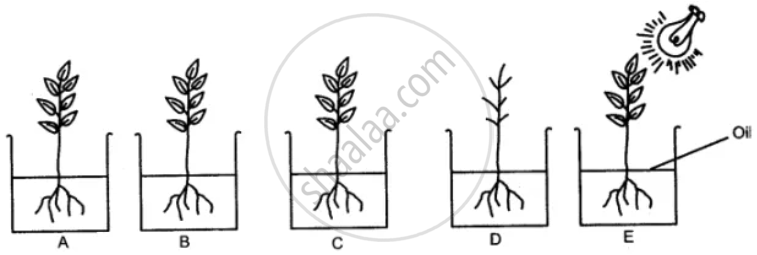 Five plants A, B, C, D, and E were placed in a beaker containing water. The water in each beaker was covered with a layer of oil. The leaves were removed from plant D in plant B, upper surfaces of all the leaves were covered with Vaseline, in-plant C the lower surfaces of all the leaves were covered with Vaseline and plant E was exposed to strong light. The beakers were then left for a few hours and at the end of the experimental period, weights of each beaker were taken.
Write the correct answer out of the five available choices given under each question:
I. In which beaker would you expect the greatest decrease in weight?
(i) A (ii) B (iii) C (iv) D (v) E
II. In which beaker the change of weight would be minimum?
(i) A (ii) B (iii) C (iv) D (v) E
III. Which plant would remain healthy for a longer period of time?
(i) A (ii) B (iii) C (iv) D (v) E
IV. In this experiment which plant can be considered as the uncontrolled one?
(I) A (ii) B (iii) C (iv) D (v) E
V. The difference of weight would b maximum between:
(i) A and B (ii) A and C (iii) A and D (iv) A and E (v) D and E
Given below is an apparatus used to study a particular process in plants. Study the same and answer the questions that follow :
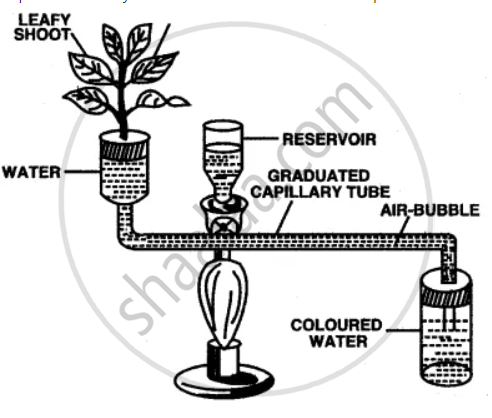
(i) Name the apparatus.
(ii) Mention one limitation of this apparatus.
(iii) Which phenomenon is studied with the help of this apparatus?
(iv) What is the function of the part marked ‘reservoir’?
(v) What is the role of the air bubble in the experiment?
ICSE solutions for Biology [English] Class 10 ICSE 4 Transpiration Sketch and Label the Diagram
Draw a labeled diagram of the stomatal apparatus and label the following in it: Stoma, Guard cells, Chloroplast, Epidermal cells, and Cell wall.
Draw a neat diagram of the stomatal apparatus found in the epidermis of leaves and label the Stoma, Guard cells, Chloroplast, Epidermal Cells, cell wall and Nucleus.
ICSE solutions for Biology [English] Class 10 ICSE 4 Transpiration Explain the Terms
Explain the Term
Transpiration
Explain the term:
Cuticular transpiration
Explain the Term
Lenticular
Explain the Term
Stomatal transpiration
Explain the term:
Guttation
Explain the Term
Bleeding
Explain the Term
Lenticel
Explain the Term :
Hydathode
Explain the Term :
Wilting
ICSE solutions for Biology [English] Class 10 ICSE 4 Transpiration Name the Following
Name the following:
The process of getting rid of excess water in the form of water vapour through the stomata.
Name the following:
Season in which the transpiration rate is the highest.
Name the following:
Holes present on the surface of the stems and twigs for transpiration.
Name the following:
A potometer is an instrument for measuring the rate of the most transpiration in a herbaceous plant like Balsam occurs through which part.
Name the following:
Plants in which lenticular transpiration.
Name the following:
A plant having sunken stomata.
Name the following:
Loss of water as droplets through leaves of an intact plant.
Name the following:
The structures through which guttation occurs.
Name the following:
The escape of plant sap from the ruptured or cut surfaces of the plant due to root pressure.
ICSE solutions for Biology [English] Class 10 ICSE 4 Transpiration Give Technical Terms
Give Technical Term
Loss of water from the aerial parts of a plant.
Give Technical Term
Opening found on the undersurface of the dorsiventral leaf.
Give Technical Term
Which side of the leaf has more stomata?
Give Technical Term
When cobalt chloride paper is placed on lower and upper surface of the leaf, the paper of which side becomes more pink?
Give Technical Term
The substances which check the rate of transpiration.
Give Technical Term
A chemical used to prevent excessive transpiration in plants.
Give Technical Term
Main function of lenticel.
Give Technical Term
The apparatus used to compare the rate of transpiration in cut shoot.
Give Technical Term
The process by which excess of water is forced out directly from the tips of veins in the leaf.
ICSE solutions for Biology [English] Class 10 ICSE 4 Transpiration Fill in the Blanks
Complete the following sentence with appropriate word:
Plants become cool as a result of __________.
Complete the following sentence with appropriate word:
Transpiration is the loss of water__________________from the leaves of the plant.
Complete the following sentence with appropriate word:
Transpiration normally takes place in the presence of ___________.
Complete the following sentence with appropriate word:
95% of the total transpiration takes place through ________.
Complete the following sentence with appropriate word:
In Nerium, the stomata are present in _________.
Complete the following sentence with appropriate word:
Openings found on the undersurface of the dorsiventral leaf are ___________.
Complete the following sentence with appropriate word:
The leaves of the __________ plants have cuticular wax.
Complete the following sentence with appropriate word:
Guttation takes place generally at _____.
ICSE solutions for Biology [English] Class 10 ICSE 4 Transpiration True & False
Mention, if the following statement is True or False. If false rewrite the wrong statement in its correct form:
Transpiration is a physiological process
True
False
Mention, if the following statement is True or False. If false rewrite the wrong statement in its correct form:
Root hairs are the extensions of the outer epidermal cells of the root
True
False
Mention, if the following statement is True or False. If false rewrite the wrong statement in its correct form:
More transpiration occurs from the upper surface of a leaf.
True
False
Mention, if the following statement is True or False. If false rewrite the wrong statement in its correct form:
Transpiration takes place only in green plants
True
False
Mention, if the following statement is True or False. If false rewrite the wrong statement in its correct form:
The pH of the guard cells increases during day time
True
False
Mention, if the following statement is True or False. If false rewrite the wrong statement in its correct form:
Evaporation is a physiological process
True
False
Mention, if the following statement is True or False. If false rewrite the wrong statement in its correct form:
Potometer is an instrument, used for measuring the rate of transpiration
True
False
True
False
Mention, if the following statement is True or False. If false rewrite the wrong statement in its correct form:
Calcium chloride paper is used to demonstrate transpiration
True
False
Mention, if the following statement is True or False. If false rewrite the wrong statement in its correct form:
Moist cobalt chloride paper is blue in colour.
True
False
Mention, if the following statement is True or False. If false rewrite the wrong statement in its correct form:
Guttation occurs through stomata.
True
False
ICSE solutions for Biology [English] Class 10 ICSE 4 Transpiration State the Location
State the Location:
Stomata
State the Location:
Lenticels
State the Location:
Cuticle
State the Location:
Hydathodes
State the Location:
Guard cells
ICSE solutions for Biology [English] Class 10 ICSE 4 Transpiration State the Function
Write the functional activity of the following structure:
Stomata
Write the functional activity of the following structure:
Lenticels
Write the functional activity of the following structure:
Cuticle
Write the functional activity of the following structure:
Hydathodes
Write the functional activity of the following structure:
Guard cells
ICSE solutions for Biology [English] Class 10 ICSE 4 Transpiration Choose the Odd One Out
Choose the Odd One Out
Transpiration
Photosynthesis
Phagocytosis
Guttation
Choose the Odd One Out
Cuficular transpiration
Lenticular transpiration
Stomatal transpiration
Guttation
Choose the Odd One Out
Stomata
Cuticle
Lenticels
Hydathodes
ICSE solutions for Biology [English] Class 10 ICSE 4 Transpiration Multiple Choice Questions
Mark the most appropriate answer in the following:
In the mechanism of opening and closing of stomata, the important factor is
The presence of chloroplast in the guard cells
The turgid and flaccid state of the guard cells
The protein content of the cells
The starch content of the cells
Mark the most appropriate answer in the following:
Stomata open during day and close at night because:
Photosynthesis occurs during day time only
Enzymes convert starch into sugar at elevated pH in night
Loss of sugar increases osmotic concentration of the cell sap
Loss of starch in day time raises OP of subsidiary cells
Mark the most appropriate answer in the following:
In hot summer days, plant cooling is due to :
Loss of water vapours from leaves
Transport of water in a plant
Loss of liquid water
Loss of water from the entire plant
Mark the most appropriate answer in the following:
If the rate of transpiration becomes more than the rate of photosynthesis, plant will ______
Continue to live, but will not be able to store food.
Be killed instantly.
Grow more vigorously because more energy will be available.
Stop growing and gradually die of starvation.
Mark the most appropriate answer in the following:
Transpiration is very low during storms due to:
Presence of moisture in the wind
Low temperature during storms
High velocity of wind
None of the above
Mark the most appropriate answer in the following:
Transpiration pull will be maximum under which of the following conditions?
Open stomata, dry atmosphere and moist soil.
Open stomata, high humid atmosphere and well irrigated soil.
Open stomata, high humid atmosphere and dry soil.
Closed stomata, dry atmosphere and dry soil.
Mark the most appropriate answer in the following:
Plants lose water by guttation when:
Rate of transpiration is high
Soil is wet and the atmosphere is humid
Soil is dry and the atmosphere is dry
Soil is wet and atmosphere is dry
Mark the most appropriate answer in the following:
Guttation is the elimination of excess of water from plants through:
Stomata
Hydathodes
Lenticels
Wounds
ICSE solutions for Biology [English] Class 10 ICSE 4 Transpiration Match the Column
Column ‘II’ is a list of items related to ideas in Column ‘I’. Match the term in Column ‘II’ with a suitable idea given in Column ‘I’.
| Column I | Column II |
| (i) Transpiration | (a) Cacti plants |
| (ii) Movement of water | (b) Stomata |
| (iii) Guttation | (c) Maize plant |
| (iv) Low rate of transpiration | (d)Xylem |
| (v) The high rate of transpiration | (e) Hydathodes |
Solutions for 4: Transpiration
ICSE solutions for Biology [English] Class 10 ICSE chapter 4 - Transpiration
Shaalaa.com has the CISCE Mathematics Biology [English] Class 10 ICSE CISCE solutions in a manner that help students grasp basic concepts better and faster. The detailed, step-by-step solutions will help you understand the concepts better and clarify any confusion. ICSE solutions for Mathematics Biology [English] Class 10 ICSE CISCE 4 (Transpiration) include all questions with answers and detailed explanations. This will clear students' doubts about questions and improve their application skills while preparing for board exams.
Further, we at Shaalaa.com provide such solutions so students can prepare for written exams. ICSE textbook solutions can be a core help for self-study and provide excellent self-help guidance for students.
Concepts covered in Biology [English] Class 10 ICSE chapter 4 Transpiration are Measurement of Transpiration > Weighing Method, Factors Affecting the Rate of Transpiration, Plant Adaptations to Reduce Transpiration, Significance of Transpiration, Guttation and Bleeding, Demonstration of Transpiration, Measurement of Transpiration > Potometer Method, Types of Transpiration > Stomatal Transpiration, Types of Transpiration > Cuticular Transpiration, Types of Transpiration > Lenticular Transpiration, Traspiration Vs Bleeding.
Using ICSE Biology [English] Class 10 ICSE solutions Transpiration exercise by students is an easy way to prepare for the exams, as they involve solutions arranged chapter-wise and also page-wise. The questions involved in ICSE Solutions are essential questions that can be asked in the final exam. Maximum CISCE Biology [English] Class 10 ICSE students prefer ICSE Textbook Solutions to score more in exams.
Get the free view of Chapter 4, Transpiration Biology [English] Class 10 ICSE additional questions for Mathematics Biology [English] Class 10 ICSE CISCE, and you can use Shaalaa.com to keep it handy for your exam preparation.
