Advertisements
Advertisements
Question
Study the diagram given alongside and answer the questions that follow:

(i) Explain the physiological process of being study.
(ii) What will be the observations in the two test-tubes after about 2-3 days?
(iii) Give a reason for your answer in (ii) above.
(iv) Why is the surface of water covered with oil?
(v) State the purpose of setting up test tube B.
Advertisements
Solution
(i) Transpiration: Loss of water as water vapour from aerial parts of the plant.
(ii) After 2-3 days the level of waterfalls in test-tube A while it remains constant in test tube B.
(iii) The fall in the level of water in test-tube A due to the absorption of water by the roots.
(iv) The oil has been put in each test-tube to prevent the loss of water by evaporation.
(v) The purpose of setting up test-tube B is to show that in the absence of a plant, there is no change in the level of water.
RELATED QUESTIONS
Mark the most appropriate answer in the following:
Transpiration pull will be maximum under which of the following conditions?
Briefly explain how the rate of transpiration is affected by:
Humidity of the atmosphere
The figure given below represents an experimental setup with a weighing machine to demonstrate a particular process in plants. The experimental setup was placed in bright sunlight. Study the diagram and answer the following questions.
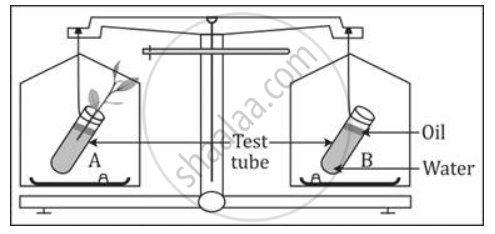
When the weight of the test tubes A and B is taken before and after the experiment, what change is observed? Justify.
Give Reasons for the following:
Land plants die if their roots remain waterlogged.
Explain the Term
Lenticular
Name the three types of transpiration.
Study the diagram given below and answer the questions that follow:
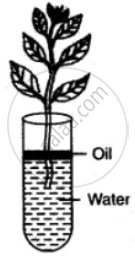
(i) Name the process being studied in the above experiment.
(ii) Explain the process mentioned in (i) above.
(iii) Why is oil placed over water?
Name the following:
Holes present on the surface of the stems and twigs for transpiration.
Mention, if the following statement is True or False. If false rewrite the wrong statement in its correct form:
Transpiration takes place only in green plants
Mark the most appropriate answer in the following:
Transpiration is very low during storms due to:
