Advertisements
Advertisements
Question
An outline sketch of a tree is shown in a diagram below. Study the same and answer the questions that follow:

- Name and define the phenomenon labelled A in the diagram.
- Write the significance of the process mentioned in A for the plants.
- What do the direction of the arrows in B and C indicate? Name the phenomena.
- Draw a neat and labelled diagram of an opened stomata.
Advertisements
Solution
- Transpiration, in plants, is the evaporative loss of water from aerial portions (leaves and stems).
- Significance of transpiration for the plants:
- Cooling effect
- Creating Suction force
- Distribution of water and minerals.
- Arrow B shows water rising up the trunk, and the phenomenon is lenticular transpiration in the ascent of sap.
Endosmosis is the phenomenon whereby arrow C denotes water absorbed by roots from the earth. 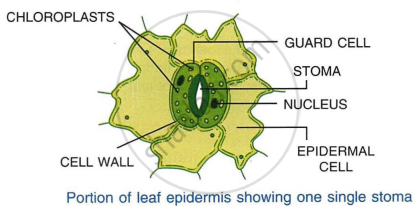
APPEARS IN
RELATED QUESTIONS
Name the factors which affect the rate of transpiration? State their role in each case.
Describe an experiment to show that the plant loses water through its leaves.
Which of the following statements are true and which ones are false? Give reason in support of your answer.
Atmospheric humidity promotes transpiration from a green plant.
Given below is an apparatus which was setup to investigate a physiological process in plants. The setup was placed in bright sunlight. Answer the questions that follow:
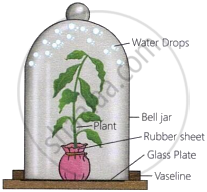
- Name the process being studied. Define the process.
- Why was the pot enclosed in a rubber sheet?
- Mention two external factors which can accelerate the above process.
- List two adaptations in plants to reduce the above process.
- Draw a neat, labelled diagram of a stomatal apparatus.
Choose the correct answer:
Transpiration generates __________
The figure given below represents an experimental setup with a weighing machine to demonstrate a particular process in plants. The experimental setup was placed in bright sunlight. Study the diagram and answer the following questions.
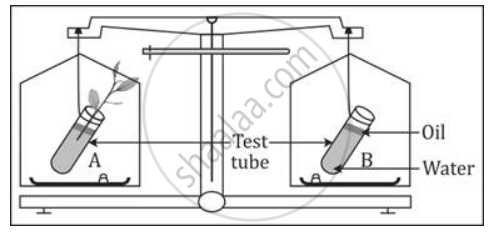
Define the above mentioned process.
What is meant by the term transpiration stream?
What are the disadvantages of transpiration?
Explain the Term
Lenticel
Mention, if the following statement is True or False. If false rewrite the wrong statement in its correct form:
More transpiration occurs from the upper surface of a leaf.
