Advertisements
Advertisements
प्रश्न
An outline sketch of a tree is shown in a diagram below. Study the same and answer the questions that follow:

- Name and define the phenomenon labelled A in the diagram.
- Write the significance of the process mentioned in A for the plants.
- What do the direction of the arrows in B and C indicate? Name the phenomena.
- Draw a neat and labelled diagram of an opened stomata.
Advertisements
उत्तर
- Transpiration, in plants, is the evaporative loss of water from aerial portions (leaves and stems).
- Significance of transpiration for the plants:
- Cooling effect
- Creating Suction force
- Distribution of water and minerals.
- Arrow B shows water rising up the trunk, and the phenomenon is lenticular transpiration in the ascent of sap.
Endosmosis is the phenomenon whereby arrow C denotes water absorbed by roots from the earth. 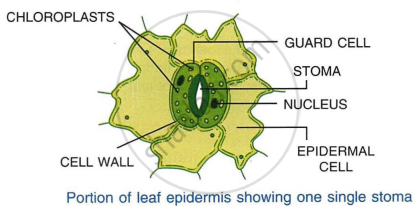
APPEARS IN
संबंधित प्रश्न
State whether the following statement is true or false. Rewrite the false statement correctly.
During transpiration, the leaves lose more water from their upper surface.
Why are the stomata in most plants more numerous on the lower surface of a leaf instead of being on the upper surface?
Mark the most appropriate answer in the following:
Transpiration pull will be maximum under which of the following conditions?
Choose the correct answer:
In herbaceous plants, following percentage of absorbed water comes out __________
Briefly explain how the rate of transpiration is affected by:
Humidity of the atmosphere
Give Reasons for the following:
Forest bring in the rain, transpiration is the cause.
Explain the term:
Cuticular transpiration
Differentiate between transpiration and guttation.
Mention, if the following statement is True or False. If false rewrite the wrong statement in its correct form:
More transpiration occurs from the upper surface of a leaf.
Give a reason/suitable explanation.
Forests tend to bring more rains.
