Advertisements
Advertisements
प्रश्न
An outline sketch of a tree is shown in a diagram below. Study the same and answer the questions that follow:

- Name and define the phenomenon labelled A in the diagram.
- Write the significance of the process mentioned in A for the plants.
- What do the direction of the arrows in B and C indicate? Name the phenomena.
- Draw a neat and labelled diagram of an opened stomata.
Advertisements
उत्तर
- Transpiration, in plants, is the evaporative loss of water from aerial portions (leaves and stems).
- Significance of transpiration for the plants:
- Cooling effect
- Creating Suction force
- Distribution of water and minerals.
- Arrow B shows water rising up the trunk, and the phenomenon is lenticular transpiration in the ascent of sap.
Endosmosis is the phenomenon whereby arrow C denotes water absorbed by roots from the earth. 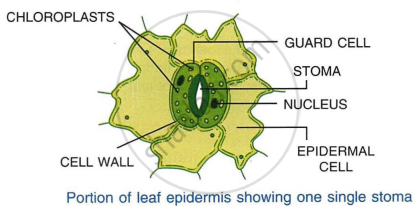
APPEARS IN
संबंधित प्रश्न
(a) State whether the following statements are True Or False?
(b) Rewrite the false statements,in the correct form by changing either the first or the last word only .
Voltmeter is an instrument used for measuring the rate of transpiration in green plants.
Distinguish between the following:
Transpiration and evaporation
Given below is an example of a certain structure and its special functional activity:
chloroplasts and photosynthesis
In a similar way, write the functional activity against the following:
Xylem and ______
Briefly explain how the rate of transpiration is affected by:
Humidity of the atmosphere
Give Reasons for the following:
Transplanting of seedlings to a flowerbed in the evening is better than doing so in the morning.
Explain the Term :
Hydathode
Explain the Term
Lenticel
Study the diagram given below and answer the questions that follow:
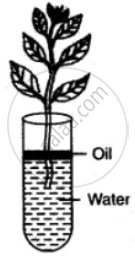
(i) Name the process being studied in the above experiment.
(ii) Explain the process mentioned in (i) above.
(iii) Why is oil placed over water?
The following diagram is set up to demonstrate an experiment.
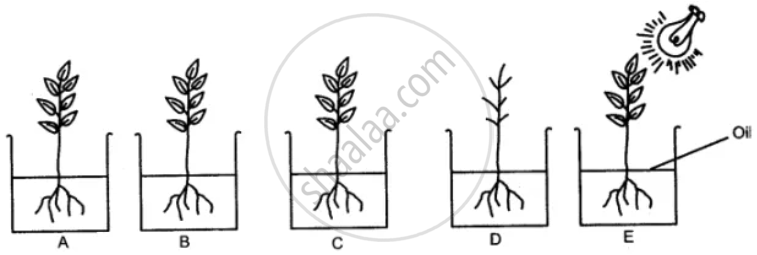 Five plants A, B, C, D, and E were placed in a beaker containing water. The water in each beaker was covered with a layer of oil. The leaves were removed from plant D in plant B, upper surfaces of all the leaves were covered with Vaseline, in-plant C the lower surfaces of all the leaves were covered with Vaseline and plant E was exposed to strong light. The beakers were then left for a few hours and at the end of the experimental period, weights of each beaker were taken.
Write the correct answer out of the five available choices given under each question:
I. In which beaker would you expect the greatest decrease in weight?
(i) A (ii) B (iii) C (iv) D (v) E
II. In which beaker the change of weight would be minimum?
(i) A (ii) B (iii) C (iv) D (v) E
III. Which plant would remain healthy for a longer period of time?
(i) A (ii) B (iii) C (iv) D (v) E
IV. In this experiment which plant can be considered as the uncontrolled one?
(I) A (ii) B (iii) C (iv) D (v) E
V. The difference of weight would b maximum between:
(i) A and B (ii) A and C (iii) A and D (iv) A and E (v) D and E
