मराठी

Suppose You Have a Small Rose Plant Growing in a Pot. How Would You Demonstrate Transpiration in It? - Biology

Advertisements
Advertisements

प्रश्न

Suppose you have a small rose plant growing in a pot. How would you demonstrate transpiration in it? 

Advertisements

उत्तर

Take the small potted rose plant and cover it with a transparent polythene bag. Tie its mouth around the base of the stem. Leave the plant in sunlight for an hour or two. 
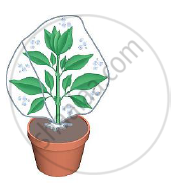
  

Drops of water will soon appear on the inner side of the bag due to the saturation of water vapour given out by the leaves. A similar empty polythene bag with its mouth tied and kept in sunlight will show no drops of water. This is the control to show that plants transpire water in the form of water. If tested with dry cobalt chloride paper, the drops will be confirmed as water only.


shaalaa.com
Significance of Transpiration
  या प्रश्नात किंवा उत्तरात काही त्रुटी आहे का?

संबंधित प्रश्‍न

Answer the following (only in few words);

In which form, water comes out in transpiration?


What is the difference between transpiration and evaporation?

Why do plants absorb more water than what is required by them? Give three uses of this phenomenon.

Give Reasons for the following:
Plants absorb more water than their requirement


Explain the term:

Cuticular transpiration


The figure given below represents an experimental setup with a weighing machine to demonstrate a particular process in plants. The experimental set-up was placed in bright sunlight. Study the diagram and answer the following questions:

  1. Name the process intended for the study.
  2. Define the above mentioned process.
  3. When the weight of the test tubes (A and B) is taken before and after the experiment, what is observed? Give reasons to justify your observations in A & B.
  4. What is the purpose of keeping the test tube B in the experimental set-up?
  5. What is the purpose of putting oil in the test tube?

The following diagram is set up to demonstrate an experiment.

Five plants A, B, C, D, and E were placed in a beaker containing water. The water in each beaker was covered with a layer of oil. The leaves were removed from plant D in plant B, upper surfaces of all the leaves were covered with Vaseline, in-plant C the lower surfaces of all the leaves were covered with Vaseline and plant E was exposed to strong light. The beakers were then left for a few hours and at the end of the experimental period, weights of each beaker were taken.
Write the correct answer out of the five available choices given under each question:
I. In which beaker would you expect the greatest decrease in weight?
(i) A (ii) B (iii) C (iv) D (v) E
II. In which beaker the change of weight would be minimum?
(i) A (ii) B (iii) C (iv) D (v) E
III. Which plant would remain healthy for a longer period of time?
(i) A (ii) B (iii) C (iv) D (v) E
IV. In this experiment which plant can be considered as the uncontrolled one?
(I) A (ii) B (iii) C (iv) D (v) E
V. The difference of weight would b maximum between:
(i) A and B (ii) A and C (iii) A and D (iv) A and E (v) D and E


Name the following:

Holes present on the surface of the stems and twigs for transpiration.


Column ‘II’ is a list of items related to ideas in Column ‘I’. Match the term in Column ‘II’ with a suitable idea given in Column ‘I’.

Column I Column II
(i) Transpiration (a) Cacti plants
(ii) Movement of water (b) Stomata
(iii) Guttation (c) Maize plant
(iv) Low rate of transpiration (d)Xylem
(v) The high rate of transpiration (e) Hydathodes

Transpiration is significant for all except ______.


Share
Notifications

Englishहिंदीमराठी


      Forgot password?
Use app×