Advertisements
Advertisements
Question
Suppose you have a small rose plant growing in a pot. How would you demonstrate transpiration in it?
Advertisements
Solution
Take the small potted rose plant and cover it with a transparent polythene bag. Tie its mouth around the base of the stem. Leave the plant in sunlight for an hour or two.
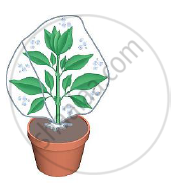
Drops of water will soon appear on the inner side of the bag due to the saturation of water vapour given out by the leaves. A similar empty polythene bag with its mouth tied and kept in sunlight will show no drops of water. This is the control to show that plants transpire water in the form of water. If tested with dry cobalt chloride paper, the drops will be confirmed as water only.
RELATED QUESTIONS
Transpiration pull will be maximum under which set of the following conditions?
Which of the following statements are true and which ones are false? Give reason in support of your answer.
Most transpiration occurs during midday.
Answer the following (only in few words);
Give one important difference between transpiration and evaporation.
Distinguish between the following:
Transpiration and evaporation
Give Reasons for the following:
Balsam plants wilt during midday even if the soil is well watered.
Mention, if the following statement is True or False. If false rewrite the wrong statement in its correct form:
More transpiration occurs from the upper surface of a leaf.
Mark the most appropriate answer in the following:
In hot summer days, plant cooling is due to :
Mark the most appropriate answer in the following:
Transpiration is very low during storms due to:
Transpiration is significant for all except ______.
