Advertisements
Advertisements
Question
Give Reasons for the following:
Forest bring in the rain, transpiration is the cause.
Advertisements
Solution
When water is lost by evaporation (transpiration) heat energy is taken up from the plant body to vapourize the water, here the water is rapidly taken up by the roots and again released through the leaves by transpiration. In the air above, the moisture forms clouds and soon falls as rain.
RELATED QUESTIONS
Briefly explain how the rate of transpiration is affected by
Intensity of light
Given below is an apparatus which has setup to investigate a physiological process in plants. The setup was placed in bright sunlight. Answer the questions that follow:
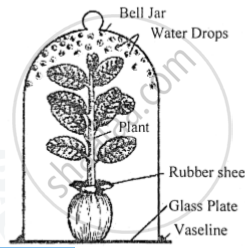
Why was the pot enclosed in a rubber sheet?
Name the following.
The process by which the aerial parts of a green plant give out water as water vapour.
Choose the correct answer:
In herbaceous plants, following percentage of absorbed water comes out __________
Choose the correct answer:
Who had said that "transpiration is a necessary evil"?
The figure given below represents an experimental setup with a weighing machine to demonstrate a particular process in plants. The experimental setup was placed in bright sunlight. Study the diagram and answer the following questions.
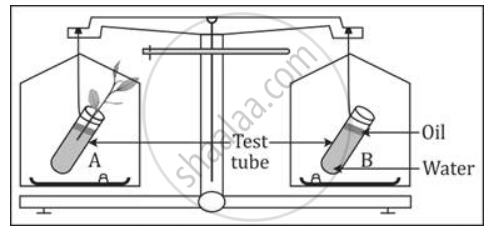
What is the purpose of keeping the test tube B in the experimental setup?
Explain the term:
Cuticular transpiration
Mention, if the following statement is True or False. If false rewrite the wrong statement in its correct form:
Transpiration is a physiological process
An outline sketch of a tree is shown in a diagram below. Study the same and answer the questions that follow:

- Name and define the phenomenon labelled A in the diagram.
- Write the significance of the process mentioned in A for the plants.
- What do the direction of the arrows in B and C indicate? Name the phenomena.
- Draw a neat and labelled diagram of an opened stomata.
