Advertisements
Advertisements
Question
Briefly explain how the rate of transpiration is affected by
Intensity of light
Advertisements
Solution
During the day, the stomata are open to facilitate the inward diffusion of carbon dioxide for photosynthesis. At night they are closed. Hence more transpiration occurs during the day. During cloudy days, the stomata are partially closed and the transpiration is reduced.

RELATED QUESTIONS
The cause of wilting is more because of ______.
Choose the correct answer:
Who had said that "transpiration is a necessary evil"?
The figure given below represents an experimental setup with a weighing machine to demonstrate a particular process in plants. The experimental setup was placed in bright sunlight. Study the diagram and answer the following questions.
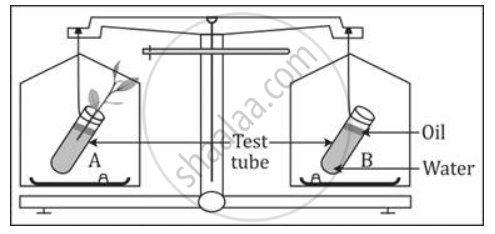
When the weight of the test tubes A and B is taken before and after the experiment, what change is observed? Justify.
Give Reasons for the following:
Balsam plants wilt during midday even if the soil is well watered.
Give Reasons for the following:
Forest bring in the rain, transpiration is the cause.
Study the diagram given below and answer the questions that follow:
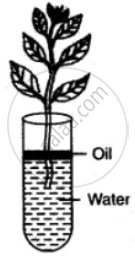
(i) Name the process being studied in the above experiment.
(ii) Explain the process mentioned in (i) above.
(iii) Why is oil placed over water?
Complete the following sentence with appropriate word:
Transpiration is the loss of water__________________from the leaves of the plant.
Column ‘II’ is a list of items related to ideas in Column ‘I’. Match the term in Column ‘II’ with a suitable idea given in Column ‘I’.
| Column I | Column II |
| (i) Transpiration | (a) Cacti plants |
| (ii) Movement of water | (b) Stomata |
| (iii) Guttation | (c) Maize plant |
| (iv) Low rate of transpiration | (d)Xylem |
| (v) The high rate of transpiration | (e) Hydathodes |
