Advertisements
Advertisements
Question
The figure given below represents an experimental setup with a weighing machine to demonstrate a particular process in plants. The experimental setup was placed in bright sunlight. Study the diagram and answer the following questions.
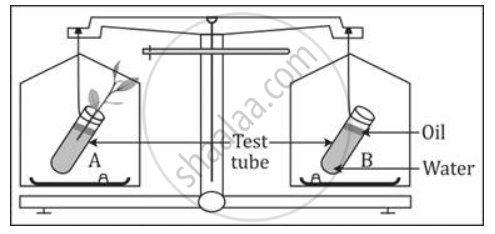
When the weight of the test tubes A and B is taken before and after the experiment, what change is observed? Justify.
Advertisements
Solution
Weight of test tube A before the experiment was more than its weight after the experiment. This is because water from test tube A has evaporated due to transpiration.
Weight of test tube B remains the same before and after the experiment, because no loss of water occurs in test tube B.
RELATED QUESTIONS
How does temperature, light intensity and wind affect transpiration?
Name the factors which affect the rate of transpiration? State their role in each case.
Transpiration pull will be maximum under which set of the following conditions?
(a) State whether the following statements are True Or False?
(b) Rewrite the false statements,in the correct form by changing either the first or the last word only .
Voltmeter is an instrument used for measuring the rate of transpiration in green plants.
Choose the correct answer:
In herbaceous plants, following percentage of absorbed water comes out __________
Explain the Term
Transpiration
Explain the Term :
Hydathode
Column ‘II’ is a list of items related to ideas in Column ‘I’. Match the term in Column ‘II’ with a suitable idea given in Column ‘I’.
| Column I | Column II |
| (i) Transpiration | (a) Cacti plants |
| (ii) Movement of water | (b) Stomata |
| (iii) Guttation | (c) Maize plant |
| (iv) Low rate of transpiration | (d)Xylem |
| (v) The high rate of transpiration | (e) Hydathodes |
