Advertisements
Advertisements
Question
Study the diagram given below and answer the questions that follow:
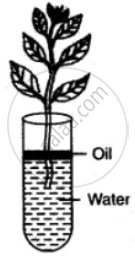
(i) Name the process being studied in the above experiment.
(ii) Explain the process mentioned in (i) above.
(iii) Why is oil placed over water?
Advertisements
Solution
(i) Transpiration
(ii) It is the process by which plants lose water as vapours through the aerial parts.
(iii) To prevent evaporation of water from the test tube.
(iv)
- In bright sunlight, the level of water decreases quickly.
- In humid conditions level of water does not decrease for a long time.
- On a windy day, the level of water decreases very quickly.
(v)
- The number of stomata may be reduced.
- leaves may become narrow.
- A thick layer of cuticle on the leaf surface helps to decrease transpiration
RELATED QUESTIONS
How does temperature, light intensity and wind affect transpiration?
Mention the two ways in which transpiration helps the plants.
Answer the following (only in few words);
In which form, water comes out in transpiration?
Given below is an example of a certain structure and its special functional activity:
chloroplasts and photosynthesis
In a similar way, write the functional activity against the following:
Xylem and ______
The figure given below represents an experimental setup with a weighing machine to demonstrate a particular process in plants. The experimental setup was placed in bright sunlight. Study the diagram and answer the following questions.
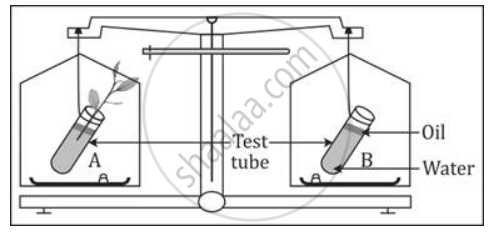
Define the above mentioned process.
What are lenticels? Where are they found?
What are the disadvantages of transpiration?
Explain the Term
Lenticular
Complete the following sentence with appropriate word:
The leaves of the __________ plants have cuticular wax.
Give a reason/suitable explanation.
Forests tend to bring more rains.
