Advertisements
Advertisements
Question
Advertisements
Solution
Transpiration is important for plants because it evaporates excess water which produces a cooling effect to plants. This process also helps in ascent of sap and transportation of water and minerals to the various parts of the plants.
APPEARS IN
RELATED QUESTIONS
Describe an experiment to show that the plant loses water through its leaves.
Given below is an apparatus which has setup to investigate a physiological process in plants. The setup was placed in bright sunlight. Answer the questions that follow: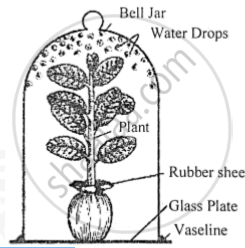
List two adaptations in plants to reduce the above process.
Given below is an apparatus which has setup to investigate a physiological process in plants. The setup was placed in bright sunlight. Answer the questions that follow: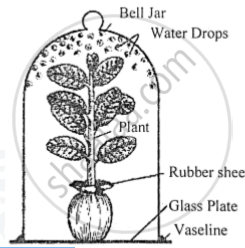
Draw a neat, labelled diagram of a stomatal apparatus.
Give Reasons for the following:
Transplanting of seedlings to a flowerbed in the evening is better than doing so in the morning.
Give Reasons for the following:
Why do some herbaceous plants show wilting of leaves during mid-day which again recover in the evening?
What are the advantages of transpiration to the plant?
Mention, if the following statement is True or False. If false rewrite the wrong statement in its correct form:
Transpiration is a physiological process
Write the functional activity of the following structure:
Guard cells
Choose the Odd One Out
