Advertisements
Advertisements
प्रश्न
Study the diagram given below and answer the questions that follow:
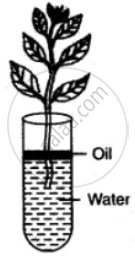
(i) Name the process being studied in the above experiment.
(ii) Explain the process mentioned in (i) above.
(iii) Why is oil placed over water?
Advertisements
उत्तर
(i) Transpiration
(ii) It is the process by which plants lose water as vapours through the aerial parts.
(iii) To prevent evaporation of water from the test tube.
(iv)
- In bright sunlight, the level of water decreases quickly.
- In humid conditions level of water does not decrease for a long time.
- On a windy day, the level of water decreases very quickly.
(v)
- The number of stomata may be reduced.
- leaves may become narrow.
- A thick layer of cuticle on the leaf surface helps to decrease transpiration
संबंधित प्रश्न
Given below is an apparatus which was setup to investigate a physiological process in plants. The setup was placed in bright sunlight. Answer the questions that follow:
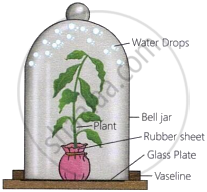
- Name the process being studied. Define the process.
- Why was the pot enclosed in a rubber sheet?
- Mention two external factors which can accelerate the above process.
- List two adaptations in plants to reduce the above process.
- Draw a neat, labelled diagram of a stomatal apparatus.
Given below is an apparatus which has setup to investigate a physiological process in plants. The setup was placed in bright sunlight. Answer the questions that follow: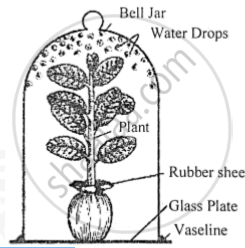
List two adaptations in plants to reduce the above process.
Briefly explain how the rate of transpiration is affected by:
Humidity of the atmosphere
The figure given below represents an experimental setup with a weighing machine to demonstrate a particular process in plants. The experimental setup was placed in bright sunlight. Study the diagram and answer the following questions.
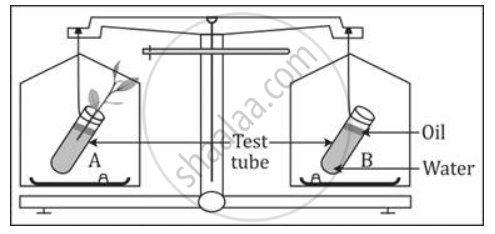
When the weight of the test tubes A and B is taken before and after the experiment, what change is observed? Justify.
Mention, if the following statement is True or False. If false rewrite the wrong statement in its correct form:
More transpiration occurs from the upper surface of a leaf.
Mention, if the following statement is True or False. If false rewrite the wrong statement in its correct form:
Transpiration takes place only in green plants
Choose the Odd One Out
