Advertisements
Advertisements
Advertisements
Solution
(i) Stomatal transpiration: Stomata are minute pores confined to the epidermis of green shoot and leaves. The opening and closing of stomata are controlled by guard cells. Maximum loss (80-90 percent of the total water loss) of water from the plant tissues takes place through the stomatal opening.

(ii) Lenticular transpiration: Loss of water in the form of water vapour taking place through the lenticels present in woody stem and fruits is called lenticular transpiration. it amounts 1-5 percent of the total water loss by the plant.

(iii) Cuticular transpiration: the loss of water in the form of water vapour through the cuticle is known as cuticular Transpiration.

RELATED QUESTIONS
How does temperature, light intensity and wind affect transpiration?
State whether the following statement is true or false. Rewrite the false statement correctly.
During transpiration, the leaves lose more water from their upper surface.
Transpiration pull will be maximum under which set of the following conditions?
Which of the following statements are true and which ones are false? Give reason in support of your answer.
Hydathodes are similar to stomata in plant physiology.
Answer the following (only in few words);
When does stomatal transpiration take place in plants?
Give Reasons for the following:
Balsam plants wilt during midday even if the soil is well watered.
What are lenticels? Where are they found?
The following diagram is set up to demonstrate an experiment.
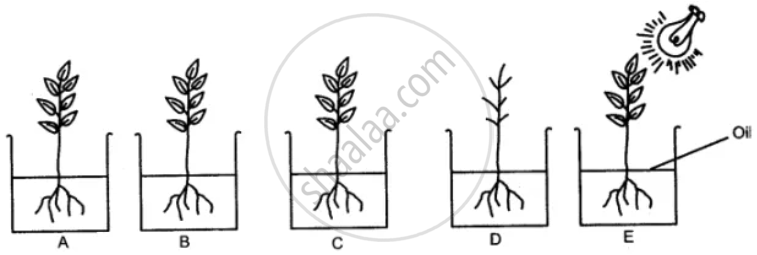 Five plants A, B, C, D, and E were placed in a beaker containing water. The water in each beaker was covered with a layer of oil. The leaves were removed from plant D in plant B, upper surfaces of all the leaves were covered with Vaseline, in-plant C the lower surfaces of all the leaves were covered with Vaseline and plant E was exposed to strong light. The beakers were then left for a few hours and at the end of the experimental period, weights of each beaker were taken.
Write the correct answer out of the five available choices given under each question:
I. In which beaker would you expect the greatest decrease in weight?
(i) A (ii) B (iii) C (iv) D (v) E
II. In which beaker the change of weight would be minimum?
(i) A (ii) B (iii) C (iv) D (v) E
III. Which plant would remain healthy for a longer period of time?
(i) A (ii) B (iii) C (iv) D (v) E
IV. In this experiment which plant can be considered as the uncontrolled one?
(I) A (ii) B (iii) C (iv) D (v) E
V. The difference of weight would b maximum between:
(i) A and B (ii) A and C (iii) A and D (iv) A and E (v) D and E
Name the following:
Plants in which lenticular transpiration.
