Advertisements
Advertisements
प्रश्न
Explain the Term
Lenticel
Advertisements
उत्तर
Lenticel: A pore in the periderm of a woody stem. It acts as an organ of gaseous exchange.
संबंधित प्रश्न
Fill in the blank with the suitable term given below:
Transpiration is reduced if the air is __________.
Why are the stomata in most plants more numerous on the lower surface of a leaf instead of being on the upper surface?
Mark the most appropriate answer in the following:
Transpiration pull will be maximum under which of the following conditions?
The diagram alongside represents a structure found in a leaf. Study the same and answer the questions that follow:
(i) Name the parts labeled A and B.
(ii) What is the biological term for the above structure?
(iii) What is the function of the part labeled A?
(iv) Mention two structural features of A, which help in the function mentioned in (iii) above?
(v) Where is this structure likely to be found in a leaf?
(vi) The structure (fig.5.22) helps in the process of transpiration. Explain the term transpiration.
(vii) How many other cells are found surrounding this structure as seen in the diagram?

The figure given below represents an experimental setup with a weighing machine to demonstrate a particular process in plants. The experimental setup was placed in bright sunlight. Study the diagram and answer the following questions.
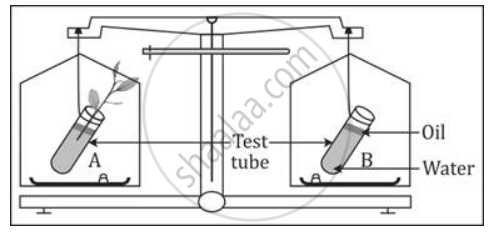
Define the above mentioned process.
Explain the Term :
Wilting
Differentiate Between Transpiration and Translocation.
Differentiate Between Transpiration and Perspiration.
The following diagram is set up to demonstrate an experiment.
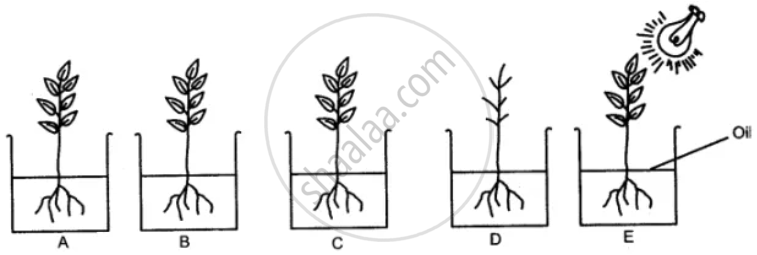 Five plants A, B, C, D, and E were placed in a beaker containing water. The water in each beaker was covered with a layer of oil. The leaves were removed from plant D in plant B, upper surfaces of all the leaves were covered with Vaseline, in-plant C the lower surfaces of all the leaves were covered with Vaseline and plant E was exposed to strong light. The beakers were then left for a few hours and at the end of the experimental period, weights of each beaker were taken.
Write the correct answer out of the five available choices given under each question:
I. In which beaker would you expect the greatest decrease in weight?
(i) A (ii) B (iii) C (iv) D (v) E
II. In which beaker the change of weight would be minimum?
(i) A (ii) B (iii) C (iv) D (v) E
III. Which plant would remain healthy for a longer period of time?
(i) A (ii) B (iii) C (iv) D (v) E
IV. In this experiment which plant can be considered as the uncontrolled one?
(I) A (ii) B (iii) C (iv) D (v) E
V. The difference of weight would b maximum between:
(i) A and B (ii) A and C (iii) A and D (iv) A and E (v) D and E
