Advertisements
Advertisements
प्रश्न
Mark the most appropriate answer in the following:
Transpiration pull will be maximum under which of the following conditions?
पर्याय
Open stomata, dry atmosphere and moist soil.
Open stomata, high humid atmosphere and well irrigated soil.
Open stomata, high humid atmosphere and dry soil.
Closed stomata, dry atmosphere and dry soil.
Advertisements
उत्तर
open stomata, dry atmosphere and moist soil.
संबंधित प्रश्न
Mention the two ways in which transpiration helps the plants.
Which of the following statements are true and which ones are false? Give reason in support of your answer.
Most transpiration occurs during midday.
Why are the stomata in most plants more numerous on the lower surface of a leaf instead of being on the upper surface?
Given below is an apparatus which has setup to investigate a physiological process in plants. The setup was placed in bright sunlight. Answer the questions that follow:
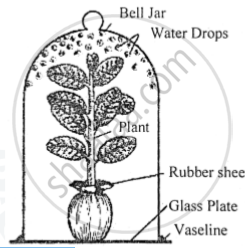
Why was the pot enclosed in a rubber sheet?
What is meant by the term transpiration stream?
The figure given below represents an experimental setup with a weighing machine to demonstrate a particular process in plants. The experimental set-up was placed in bright sunlight. Study the diagram and answer the following questions:
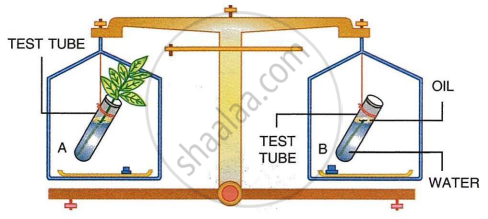
- Name the process intended for the study.
- Define the above mentioned process.
- When the weight of the test tubes (A and B) is taken before and after the experiment, what is observed? Give reasons to justify your observations in A & B.
- What is the purpose of keeping the test tube B in the experimental set-up?
- What is the purpose of putting oil in the test tube?
Mention, if the following statement is True or False. If false rewrite the wrong statement in its correct form:
Transpiration takes place only in green plants
State the Location:
Cuticle
Write the functional activity of the following structure:
Hydathodes
