Advertisements
Advertisements
प्रश्न
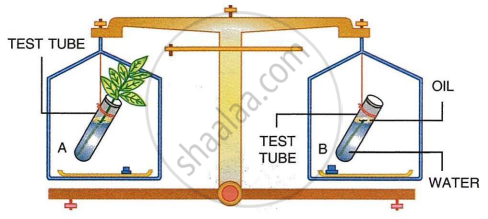
The figure given below represents an experimental setup with a weighing machine to demonstrate a particular process in plants. The experimental set-up was placed in bright sunlight. Study the diagram and answer the following questions:
- Name the process intended for the study.
- Define the above mentioned process.
- When the weight of the test tubes (A and B) is taken before and after the experiment, what is observed? Give reasons to justify your observations in A & B.
- What is the purpose of keeping the test tube B in the experimental set-up?
- What is the purpose of putting oil in the test tube?
Advertisements
उत्तर
- Transpiration.
- It is the release of water vapours from the surface of the plant, mainly from the leaves.
-
- Before: the weights of A and B are the same.
- After: 'A' gets lighter as it loses water from transpiration; 'B' stays the same since evaporation causes no loss of water as the surface of water is covered with oil.
- 'B' acts as a control to show that transpiration from the aerial parts I leave of the plant causes water to evaporate.
- By adding oil to the test tube, one hopes to prevent water from evaporating from it.
APPEARS IN
संबंधित प्रश्न
Which one of the following favours the fastest transpiration rate?
Transpiration helps in creating ______ force and in eliminating excess ______.
Suppose you have a small rose plant growing in a pot. How would you demonstrate transpiration in it?
Given below is an apparatus which has setup to investigate a physiological process in plants. The setup was placed in bright sunlight. Answer the questions that follow:
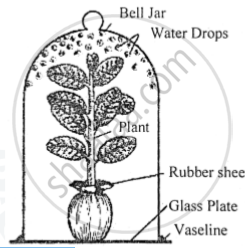
Why was the pot enclosed in a rubber sheet?
From which structure cuticular transpiration occur in plants?
Mark the most appropriate answer in the following:
Transpiration pull will be maximum under which of the following conditions?
Mention, if the following statement is True or False. If false rewrite the wrong statement in its correct form:
More transpiration occurs from the upper surface of a leaf.
Write the functional activity of the following structure:
Cuticle
Choose the Odd One Out
