Advertisements
Advertisements
प्रश्न
The diagram alongside represents a structure found in a leaf. Study the same and answer the questions that follow:
(i) Name the parts labeled A and B.
(ii) What is the biological term for the above structure?
(iii) What is the function of the part labeled A?
(iv) Mention two structural features of A, which help in the function mentioned in (iii) above?
(v) Where is this structure likely to be found in a leaf?
(vi) The structure (fig.5.22) helps in the process of transpiration. Explain the term transpiration.
(vii) How many other cells are found surrounding this structure as seen in the diagram?

Advertisements
उत्तर
(i) A = Guard cell
B = Stomatal aperture
(ii) Stomata
(iii) The function of the guard cells are that they help to regulate the rate of transpiration by opening and closing the stomata thus preventing excessive water loss.
(iv) The two structural features of guard cells are :
1.The guard cells have thin outer wall and thick inner wall.
2. Guard cells contain chloroplast in their cytoplasm.
(v) These are present on the lower surface of the dorsiventral leaf.
(vi) Transpiration is the loss of water in the form of water vapour from aerial parts of the plant.
(vii) Five
संबंधित प्रश्न
How does temperature, light intensity and wind affect transpiration?
(a) State whether the following statements are True Or False?
(b) Rewrite the false statements,in the correct form by changing either the first or the last word only .
Voltmeter is an instrument used for measuring the rate of transpiration in green plants.
Which of the following statements are true and which ones are false? Give reason in support of your answer.
Atmospheric humidity promotes transpiration from a green plant.
Given below is an apparatus which has setup to investigate a physiological process in plants. The setup was placed in bright sunlight. Answer the questions that follow:
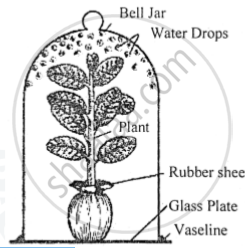
Why was the pot enclosed in a rubber sheet?
Choose the correct answer:
Who had said that "transpiration is a necessary evil"?
Give Reasons for the following:
Why do some herbaceous plants show wilting of leaves during mid-day which again recover in the evening?
Complete the following sentence with appropriate word:
Transpiration is the loss of water__________________from the leaves of the plant.
Complete the following sentence with appropriate word:
The leaves of the __________ plants have cuticular wax.
Mention, if the following statement is True or False. If false rewrite the wrong statement in its correct form:
Transpiration takes place only in green plants
State the Location:
Lenticels
