Advertisements
Advertisements
प्रश्न
The diagram alongside represents a structure found in a leaf. Study the same and answer the questions that follow:
(i) Name the parts labeled A and B.
(ii) What is the biological term for the above structure?
(iii) What is the function of the part labeled A?
(iv) Mention two structural features of A, which help in the function mentioned in (iii) above?
(v) Where is this structure likely to be found in a leaf?
(vi) The structure (fig.5.22) helps in the process of transpiration. Explain the term transpiration.
(vii) How many other cells are found surrounding this structure as seen in the diagram?

Advertisements
उत्तर
(i) A = Guard cell
B = Stomatal aperture
(ii) Stomata
(iii) The function of the guard cells are that they help to regulate the rate of transpiration by opening and closing the stomata thus preventing excessive water loss.
(iv) The two structural features of guard cells are :
1.The guard cells have thin outer wall and thick inner wall.
2. Guard cells contain chloroplast in their cytoplasm.
(v) These are present on the lower surface of the dorsiventral leaf.
(vi) Transpiration is the loss of water in the form of water vapour from aerial parts of the plant.
(vii) Five
संबंधित प्रश्न
Fill in the blank with the suitable term given below:
Transpiration is reduced if the air is __________.
Name the factors which affect the rate of transpiration? State their role in each case.
Mention the two ways in which transpiration helps the plants.
Describe an experiment to show that the plant loses water through its leaves.
Answer the following (only in few words);
Give one important difference between transpiration and evaporation.
Distinguish between the following:
Transpiration and evaporation
The figure given below represents an experimental setup with a weighing machine to demonstrate a particular process in plants. The experimental setup was placed in bright sunlight. Study the diagram and answer the following questions.
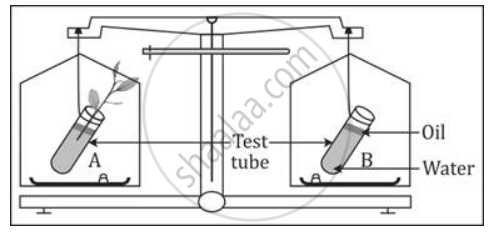
Define the above mentioned process.
Differentiate Between Cuticular and Lenticular transpiration.
Name the following:
Plants in which lenticular transpiration.
Complete the following sentence with appropriate word:
Transpiration normally takes place in the presence of ___________.
