Advertisements
Advertisements
Question
The diagram alongside represents a structure found in a leaf. Study the same and answer the questions that follow:
(i) Name the parts labeled A and B.
(ii) What is the biological term for the above structure?
(iii) What is the function of the part labeled A?
(iv) Mention two structural features of A, which help in the function mentioned in (iii) above?
(v) Where is this structure likely to be found in a leaf?
(vi) The structure (fig.5.22) helps in the process of transpiration. Explain the term transpiration.
(vii) How many other cells are found surrounding this structure as seen in the diagram?

Advertisements
Solution
(i) A = Guard cell
B = Stomatal aperture
(ii) Stomata
(iii) The function of the guard cells are that they help to regulate the rate of transpiration by opening and closing the stomata thus preventing excessive water loss.
(iv) The two structural features of guard cells are :
1.The guard cells have thin outer wall and thick inner wall.
2. Guard cells contain chloroplast in their cytoplasm.
(v) These are present on the lower surface of the dorsiventral leaf.
(vi) Transpiration is the loss of water in the form of water vapour from aerial parts of the plant.
(vii) Five
RELATED QUESTIONS
Which one of the following favours the fastest transpiration rate?
Given below is an apparatus which was setup to investigate a physiological process in plants. The setup was placed in bright sunlight. Answer the questions that follow:
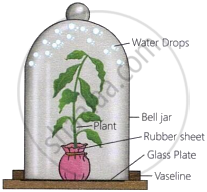
- Name the process being studied. Define the process.
- Why was the pot enclosed in a rubber sheet?
- Mention two external factors which can accelerate the above process.
- List two adaptations in plants to reduce the above process.
- Draw a neat, labelled diagram of a stomatal apparatus.
Given below is an example of a certain structure and its special functional activity:
chloroplasts and photosynthesis
In a similar way, write the functional activity against the following:
Xylem and ______
The figure given below represents an experimental setup with a weighing machine to demonstrate a particular process in plants. The experimental setup was placed in bright sunlight. Study the diagram and answer the following questions.
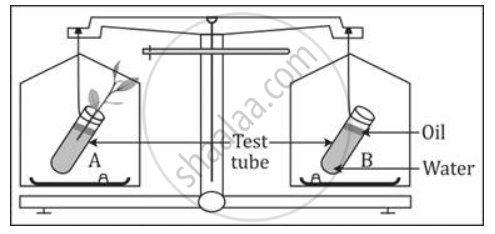
When the weight of the test tubes A and B is taken before and after the experiment, what change is observed? Justify.
Differentiate Between Transpiration and Evaporation.
State the Location:
Hydathodes
Column ‘II’ is a list of items related to ideas in Column ‘I’. Match the term in Column ‘II’ with a suitable idea given in Column ‘I’.
| Column I | Column II |
| (i) Transpiration | (a) Cacti plants |
| (ii) Movement of water | (b) Stomata |
| (iii) Guttation | (c) Maize plant |
| (iv) Low rate of transpiration | (d)Xylem |
| (v) The high rate of transpiration | (e) Hydathodes |
Mark the most appropriate answer in the following:
Transpiration is very low during storms due to:
