Advertisements
Advertisements
Question
Transpiration is significant for all except ______.
Options
Cooling effect
Suction pull
Ascent of sap
Translocation of food
Advertisements
Solution
Transpiration is significant for all except the translocation of food.
Explanation:
Phloem tissue performs translocation of food; it is not dependent on transpiration.
APPEARS IN
RELATED QUESTIONS
Describe an experiment to show that the plant loses water through its leaves.
Why are the stomata in most plants more numerous on the lower surface of a leaf instead of being on the upper surface?
Given below is an apparatus which was setup to investigate a physiological process in plants. The setup was placed in bright sunlight. Answer the questions that follow:
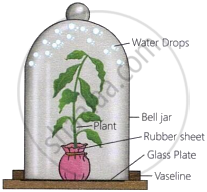
- Name the process being studied. Define the process.
- Why was the pot enclosed in a rubber sheet?
- Mention two external factors which can accelerate the above process.
- List two adaptations in plants to reduce the above process.
- Draw a neat, labelled diagram of a stomatal apparatus.
Answer the following (only in few words);
When does stomatal transpiration take place in plants?
The figure given below represents an experimental setup with a weighing machine to demonstrate a particular process in plants. The experimental setup was placed in bright sunlight. Study the diagram and answer the following questions.
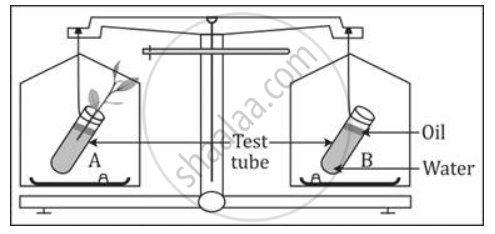
When the weight of the test tubes A and B is taken before and after the experiment, what change is observed? Justify.
What are the disadvantages of transpiration?
Name the three types of transpiration.
State the Location:
Lenticels
Column ‘II’ is a list of items related to ideas in Column ‘I’. Match the term in Column ‘II’ with a suitable idea given in Column ‘I’.
| Column I | Column II |
| (i) Transpiration | (a) Cacti plants |
| (ii) Movement of water | (b) Stomata |
| (iii) Guttation | (c) Maize plant |
| (iv) Low rate of transpiration | (d)Xylem |
| (v) The high rate of transpiration | (e) Hydathodes |
Mark the most appropriate answer in the following:
In hot summer days, plant cooling is due to :
