Advertisements
Advertisements
Question
The following diagram is set up to demonstrate an experiment.
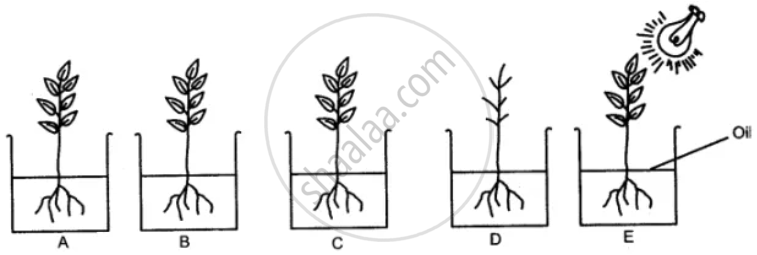 Five plants A, B, C, D, and E were placed in a beaker containing water. The water in each beaker was covered with a layer of oil. The leaves were removed from plant D in plant B, upper surfaces of all the leaves were covered with Vaseline, in-plant C the lower surfaces of all the leaves were covered with Vaseline and plant E was exposed to strong light. The beakers were then left for a few hours and at the end of the experimental period, weights of each beaker were taken.
Write the correct answer out of the five available choices given under each question:
I. In which beaker would you expect the greatest decrease in weight?
(i) A (ii) B (iii) C (iv) D (v) E
II. In which beaker the change of weight would be minimum?
(i) A (ii) B (iii) C (iv) D (v) E
III. Which plant would remain healthy for a longer period of time?
(i) A (ii) B (iii) C (iv) D (v) E
IV. In this experiment which plant can be considered as the uncontrolled one?
(I) A (ii) B (iii) C (iv) D (v) E
V. The difference of weight would b maximum between:
(i) A and B (ii) A and C (iii) A and D (iv) A and E (v) D and E
Advertisements
Solution
I. (v) E, II. (iv) D, III. (i) A, IV. (i) A, V. (v) D and E.
RELATED QUESTIONS
Describe an experiment to show that the plant loses water through its leaves.
Briefly explain how the rate of transpiration is affected by
Intensity of light
Answer the following (only in few words);
Give one important difference between transpiration and evaporation.
Choose the correct answer:
Transpiration is more ____________
Give Reasons for the following:
Land plants die if their roots remain waterlogged.
What is meant by the term transpiration stream?
Give Technical Term
Main function of lenticel.
Column ‘II’ is a list of items related to ideas in Column ‘I’. Match the term in Column ‘II’ with a suitable idea given in Column ‘I’.
| Column I | Column II |
| (i) Transpiration | (a) Cacti plants |
| (ii) Movement of water | (b) Stomata |
| (iii) Guttation | (c) Maize plant |
| (iv) Low rate of transpiration | (d)Xylem |
| (v) The high rate of transpiration | (e) Hydathodes |
Mark the most appropriate answer in the following:
In hot summer days, plant cooling is due to :
Transpiration is significant for all except ______.
