Advertisements
Advertisements
Question
Give Reasons for the following:
Land plants die if their roots remain waterlogged.
Advertisements
Solution
Older portions of the root do not have root hairs. They are covered with a protective layer of dead calls having tiny openings called lenticels. Through these lenticels, gaseous exchange occurs between the soil and inner living cells. If the roots of land plants remain waterlogged, then lenticels will not be able to do the gaseous exchange and as a result of this plants will die.
RELATED QUESTIONS
Mention the two ways in which transpiration helps the plants.
Describe an experiment to show that the plant loses water through its leaves.
Transpiration pull will be maximum under which set of the following conditions?
Given below is an apparatus which was setup to investigate a physiological process in plants. The setup was placed in bright sunlight. Answer the questions that follow:
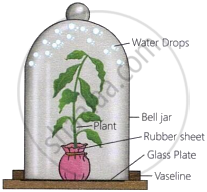
- Name the process being studied. Define the process.
- Why was the pot enclosed in a rubber sheet?
- Mention two external factors which can accelerate the above process.
- List two adaptations in plants to reduce the above process.
- Draw a neat, labelled diagram of a stomatal apparatus.
Give Reasons for the following:
Plants absorb more water than their requirement
Give Reasons for the following:
Balsam plants wilt during midday even if the soil is well watered.
What are the advantages of transpiration to the plant?
Write the functional activity of the following structure:
Cuticle
Transpiration is significant for all except ______.
