Advertisements
Advertisements
प्रश्न
Give Reasons for the following:
Land plants die if their roots remain waterlogged.
Advertisements
उत्तर
Older portions of the root do not have root hairs. They are covered with a protective layer of dead calls having tiny openings called lenticels. Through these lenticels, gaseous exchange occurs between the soil and inner living cells. If the roots of land plants remain waterlogged, then lenticels will not be able to do the gaseous exchange and as a result of this plants will die.
संबंधित प्रश्न
Describe an experiment to show that the plant loses water through its leaves.
Which of the following statements are true and which ones are false? Give reason in support of your answer.
Some desert plants have sunked stomata on their leaves.
Why are the stomata in most plants more numerous on the lower surface of a leaf instead of being on the upper surface?
Given below is an apparatus which has setup to investigate a physiological process in plants. The setup was placed in bright sunlight. Answer the questions that follow:
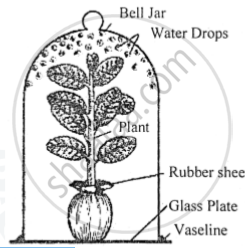
Why was the pot enclosed in a rubber sheet?
Mark the most appropriate answer in the following:
Transpiration pull will be maximum under which of the following conditions?
Choose the correct answer:
Transpiration is more ____________
Give Reasons for the following:
Transplanting of seedlings to a flowerbed in the evening is better than doing so in the morning.
Explain the term:
Cuticular transpiration
The following diagram is set up to demonstrate an experiment.
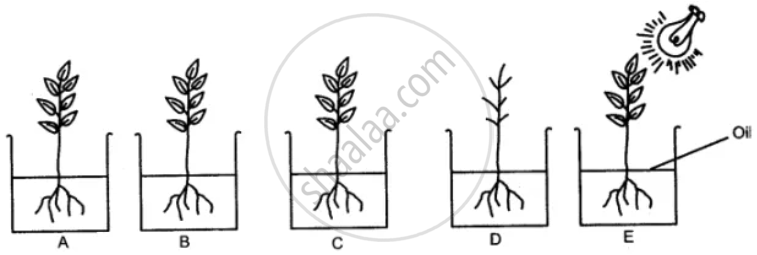 Five plants A, B, C, D, and E were placed in a beaker containing water. The water in each beaker was covered with a layer of oil. The leaves were removed from plant D in plant B, upper surfaces of all the leaves were covered with Vaseline, in-plant C the lower surfaces of all the leaves were covered with Vaseline and plant E was exposed to strong light. The beakers were then left for a few hours and at the end of the experimental period, weights of each beaker were taken.
Write the correct answer out of the five available choices given under each question:
I. In which beaker would you expect the greatest decrease in weight?
(i) A (ii) B (iii) C (iv) D (v) E
II. In which beaker the change of weight would be minimum?
(i) A (ii) B (iii) C (iv) D (v) E
III. Which plant would remain healthy for a longer period of time?
(i) A (ii) B (iii) C (iv) D (v) E
IV. In this experiment which plant can be considered as the uncontrolled one?
(I) A (ii) B (iii) C (iv) D (v) E
V. The difference of weight would b maximum between:
(i) A and B (ii) A and C (iii) A and D (iv) A and E (v) D and E
