Advertisements
Advertisements
Question
Given ahead is a diagram of an experimental setup to study the process of transpiration in plants. Study the same and then answer the question that follows:
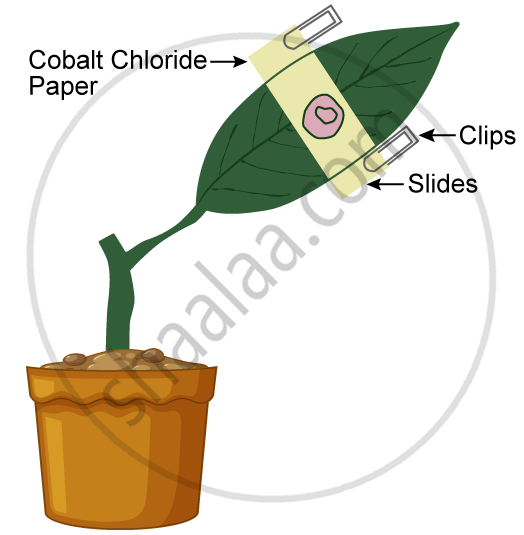
- Name the colour of dry cobalt chloride paper.
- Is the experimental leaf a monocot or a dicot? Give a reason to support your answer.
- Why are glass slides placed over the dry cobalt chloride papers?
- After about half an hour, what change, if any, would you expect to find in the cobalt chloride paper placed on the dorsal and ventral sides of the leaf? Give a reason to support your answer.
Answer in Brief
Advertisements
Solution
- The colour of dry cobalt chloride paper is blue.
- Because the experimental leaf has reticulate venation and has more stomatal holes on its underside, it is a dicot leaf. This causes more obvious transpiration.
- To keep the strips in place, glass slides are set on dried cobalt chloride sheets.
- About half an hour later, the cobalt chloride paper on the dorsal side should turn less pink or take more time to turn pink. By comparison, the ventral side paper will turn pink faster. This variation arises from the higher rate of transpiration resulting from more stomata on the ventral surface of a dicot leaf than on its dorsal surface.
shaalaa.com
Is there an error in this question or solution?
