Advertisements
Advertisements
Question
Given below is an apparatus used to study a particular process in plants. Study the same and answer the questions that follow :
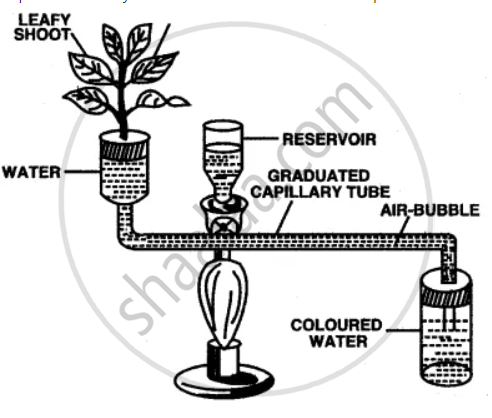
(i) Name the apparatus.
(ii) Mention one limitation of this apparatus.
(iii) Which phenomenon is studied with the help of this apparatus?
(iv) What is the function of the part marked ‘reservoir’?
(v) What is the role of the air bubble in the experiment?
Advertisements
Solution
(i) Garreau’s Potometer.
(ii) The capillary tube should be properly dipped into the water.
(iii) Transpiration.
(iv) It is used to adjust the position of air bubble in graduated capillary tube.
(v) The movement of air bubble in graduated tube in a minute gives the rate of transpiration.
APPEARS IN
RELATED QUESTIONS
Choose the correct answer:
Stomata can open in night also in _______________
Given ahead is a diagram of an experimental setup to study the process of transpiration in plants. Study the same and then answer the question that follows:

- Name the colour of dry cobalt chloride paper.
- Is the experimental leaf a monocot or a dicot? Give a reason to support your answer.
- Why are glass slides placed over the dry cobalt chloride papers?
- After about half an hour, what change, if any, would you expect to find in the cobalt chloride paper placed on the dorsal and ventral sides of the leaf? Give a reason to support your answer.
Given ahead is the diagram of an experimental set up to study the process of transpiration in plants. Study the same and then answer the question that follow:

After about half an hour what change, if any, would you expect to find in the cobalt chloride paper placed on the dorsal and ventral sides of the leaf? Give a reason to support your answer.
Given below is the diagram of an experimental set up to study the process of transpiration in plants. Study the same and then answer the questions that follow:

(i) What is the colour of dry cobalt chloride paper?
(ii) Is the experimental leaf a monocot or a dicot? Give a reason to support your answer.
(iii) Why axe glass slides placed over the dry cobalt chloride papers?
(iv) After about half an hour what change, if any, would you expect to find in the cobalt chloride paper placed on the dorsal and ventral sides of the leaf? Give a reason to support your answer.
(v) Define the term ‘transpiration’.
Name the following:
A potometer is an instrument for measuring the rate of the most transpiration in a herbaceous plant like Balsam occurs through which part.
Give Technical Term
Which side of the leaf has more stomata?
Mark the most appropriate answer in the following:
Stomata open during day and close at night because:
Mention the differences between stomatal and lenticular transpiration.
The paper used to demonstrate unequal transpiration in a dicot leaf is ______.
The given figure represents an experiment:

- Leaf A was coated with grease on both surfaces.
- Leaf B was coated with grease on the lower surface.
- Leaf C was coated with grease on the upper surface.
- Leaf D was left without any application of grease. All four leaves A, B, C and D were left in a room for about 24 hours.
- Which leaf dries first? Give reason.
- Which leaf dries last? Give reason.
