मराठी

Given Below is an Apparatus Used to Study a Particular Process in Plants. Study the Same and Answer the Questions that Follow : - Biology

Advertisements
Advertisements

प्रश्न

Given below is an apparatus used to study a particular process in plants. Study the same and answer the questions that follow :
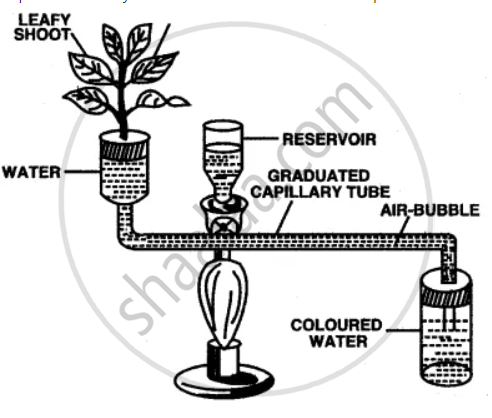
(i) Name the apparatus.
(ii) Mention one limitation of this apparatus.
(iii) Which phenomenon is studied with the help of this apparatus?
(iv) What is the function of the part marked ‘reservoir’?
(v) What is the role of the air bubble in the experiment?

थोडक्यात उत्तर
आकृती
Advertisements

उत्तर

(i) Garreau’s Potometer.
(ii) The capillary tube should be properly dipped into the water.
(iii) Transpiration.
(iv) It is used to adjust the position of air bubble in graduated capillary tube.
(v) The movement of air bubble in graduated tube in a minute gives the rate of transpiration.

shaalaa.com
Kinds of Transpiration
  या प्रश्नात किंवा उत्तरात काही त्रुटी आहे का?
पाठ 4: Transpiration - Diagram Based Questions

APPEARS IN

आईसीएसई Biology [English] Class 10
पाठ 4 Transpiration
Diagram Based Questions | Q 11

संबंधित प्रश्‍न

Explain the mechanism of stomata?

Explain typical structure of stomata.

Given ahead is a diagram of an experimental setup to study the process of transpiration in plants. Study the same and then answer the question that follows:

  1. Name the colour of dry cobalt chloride paper.
  2. Is the experimental leaf a monocot or a dicot? Give a reason to support your answer.
  3. Why are glass slides placed over the dry cobalt chloride papers?
  4. After about half an hour, what change, if any, would you expect to find in the cobalt chloride paper placed on the dorsal and ventral sides of the leaf? Give a reason to support your answer.

Given ahead is the diagram of an experimental set up to study the process of transpiration in plants. Study the same and then answer the question that follow:

Why are glass slides placed over the dry cobalt chloride papers?


Give Reasons for the following:
Guard cells are small in size and are kidney-shaped in outline.


The figure below represents the vertical section of a leaf:

(i) Name the parts labeled 1 to 5.
(ii) What do the two arrows (dotted and solid) indicate in the day time and at night?
(iii) Could you add one more arrow in the figure? If yes, what for?
(iv) How many leaf veins have been shown in this section?


Given below is the diagram of an experimental set up to study the process of transpiration in plants. Study the same and then answer the questions that follow:


(i) What is the colour of dry cobalt chloride paper?
(ii) Is the experimental leaf a monocot or a dicot? Give a reason to support your answer.
(iii) Why axe glass slides placed over the dry cobalt chloride papers?
(iv) After about half an hour what change, if any, would you expect to find in the cobalt chloride paper placed on the dorsal and ventral sides of the leaf? Give a reason to support your answer.
(v) Define the term ‘transpiration’.


Draw a labeled diagram of the stomatal apparatus and label the following in it: Stoma, Guard cells, Chloroplast, Epidermal cells, and Cell wall.


Complete the following sentence with appropriate word:

In Nerium, the stomata are present in _________.


The upper layer of mesophyll in a leaf consists of elongated ground tissue called ______.


Share
Notifications

Englishहिंदीमराठी


      Forgot password?
Use app×