English

The Apparatus Shown Here is Girreau’S Poto-meter Designed to Demonstrate Unequal Transpiration from the Two Surfaces of a Dorsiventral Leaf. before Keeping the Leaf in Between the Cups - Biology

Advertisements
Advertisements

Question

The apparatus shown here is Girreau’s poto-meter designed to demonstrate unequal transpiration from the two surfaces of a dorsiventral leaf. Before keeping the leaf in between the cups, anhydrous calcium chloride (CaCl2) contained in two small vials were weighed and placed in both the cups. The ends of the cups were closed with corks through which two mercury manometers were connected. After a few hours, CaCl2 vials were taken out and weighed again.
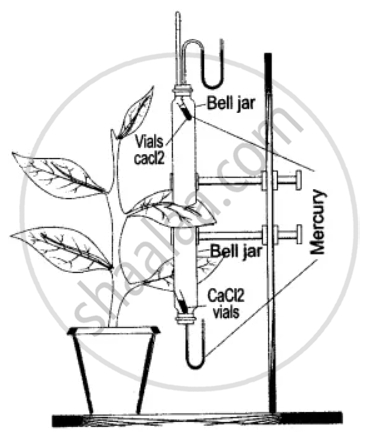
(i) What is the purpose of keeping CaCl2 vials inside the cup?
(ii) After a few hours, the CaCl2 vials were taken out and weighed again. Will you expect any difference in weight? If so, give reasons.
(iii) What was the purpose of using a mano-meter?
(iv) What do you mean by transpiration?

Answer in Brief
Diagram
Advertisements

Solution

(i) The CaCl2 vials are kept inside the cup to absorb water.
(ii) After few hours, the weight of the CaCl2 vials will increase because they will absorb the water which is transpired by the leaf of the plant.
(iii) Manometers are used to indicate the unequal transpiration from two surfaces of a dorsiveritral leaf by showing difference in rise in their mercury levels.
(iv) Transpiration is the loss of water in the form of water vapour from the aerial parts of the living plants.

shaalaa.com
Kinds of Transpiration
  Is there an error in this question or solution?
Chapter 4: Transpiration - Diagram Based Questions

APPEARS IN

ICSE Biology [English] Class 10
Chapter 4 Transpiration
Diagram Based Questions | Q 9

RELATED QUESTIONS

Given below is an example of a certain structure and its special functional activity:

Chloroplasts and Photosynthesis

In a similar way, write the functional activity against the following:

Lenticels and ______


Explain typical structure of stomata.

Given ahead is the diagram of an experimental set up to study the process of transpiration in plants. Study the same and then answer the question that follow:

After about half an hour what change, if any, would you expect to find in the cobalt chloride paper placed on the dorsal and ventral sides of the leaf? Give a reason to support your answer.


Give Reasons for the following:
Guard cells are small in size and are kidney-shaped in outline.


The figure below represents the vertical section of a leaf:

(i) Name the parts labeled 1 to 5.
(ii) What do the two arrows (dotted and solid) indicate in the day time and at night?
(iii) Could you add one more arrow in the figure? If yes, what for?
(iv) How many leaf veins have been shown in this section?


Given below is an experimental set up to study a particular process:

(i) Name the process being studied.
(ii) Explain the process named in (i) above.
(iii) Why is the pot covered with a plastic sheet?
(iv) Mention one way in which this process is beneficial to the plant.
(v) Suggest a suitable control for this experiment.


Name the following:

The process of getting rid of excess water in the form of water vapour through the stomata.


Give Technical Term
Which side of the leaf has more stomata?


Mention the differences between stomatal and lenticular transpiration.


Assertion (A): The loss of excess water from the aerial parts of the plant in the form of water vapor is known as transpiration.
Reason (R): Stomata of the leaf perform transpiration.


Share
Notifications

Englishहिंदीमराठी


      Forgot password?
Use app×