Advertisements
Advertisements
Question
Advertisements
Solution
Plants absorb more water than what is required. Out of 100%, only 5% of the water is used in metabolic reactions while the remaining 95% is released into the atmosphere as transpiration.
The three uses of this phenomenon are:
(i) It helps in transportation of water and minerals to the various parts of the plant.
(ii) It produces a cooling effect to the plants.
(iii) It evaporates excess water.
APPEARS IN
RELATED QUESTIONS
How does temperature, light intensity and wind affect transpiration?
Fill in the blank with the suitable term given below:
Transpiration is reduced if the air is __________.
Name the factors which affect the rate of transpiration? State their role in each case.
Why are the stomata in most plants more numerous on the lower surface of a leaf instead of being on the upper surface?
Answer the following (only in few words);
When does stomatal transpiration take place in plants?
Choose the correct answer:
In herbaceous plants, following percentage of absorbed water comes out __________
Explain the Term
Transpiration
Name the three types of transpiration.
The figure given below represents an experimental setup with a weighing machine to demonstrate a particular process in plants. The experimental set-up was placed in bright sunlight. Study the diagram and answer the following questions:
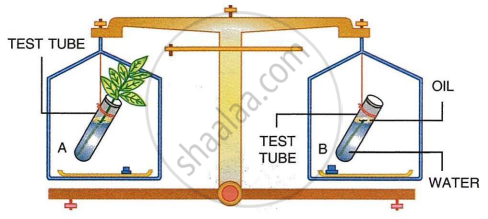
- Name the process intended for the study.
- Define the above mentioned process.
- When the weight of the test tubes (A and B) is taken before and after the experiment, what is observed? Give reasons to justify your observations in A & B.
- What is the purpose of keeping the test tube B in the experimental set-up?
- What is the purpose of putting oil in the test tube?
Transpiration is significant for all except ______.
