Advertisements
Online Mock Tests
Chapters
1: Cell Division
2: Structure of Chromosomes
3: Principles of Genetics
Unit-2 Plant Physiology
4: Absorption by Roots
5: Transpiration
6: Photosynthesis
Chapter 7: Chemical Coordination in Plants
8: Circulatory System
Unit-3 Human Anatomy and Physiology
9: Excretory System
10: Nervous System
▶ 11: Endocrine System
12: Reproductive System
13: Human Population
Chapter 14: The Evolution of Man
Chapter 15: Theories of Evolution
Chapter 16: Types of Pollution
Chapter 17: Sources of Pollution and Major Pollutants
Chapter 18: Effects of Pollution
Chapter 18: Abatement of Pollution
Chapter 20: Greenhouse Effects, Global Warming, Ozone Layer Depletion and Acid Rain
![Frank solutions for Biology Part 2 [English] Class 10 ICSE chapter 11 - Endocrine System - Shaalaa.com](/images/biology-part-2-english-class-10-icse_6:4cd9978ddb1c4f42b0b0e9ec6f09c057.jpg "Frank solutions for Biology Part 2 [English] Class 10 ICSE chapter 11 - Endocrine System")
Advertisements
Solutions for Chapter 11: Endocrine System
Below listed, you can find solutions for Chapter 11 of CISCE Frank for Biology Part 2 [English] Class 10 ICSE.
Frank solutions for Biology Part 2 [English] Class 10 ICSE 11 Endocrine System Exercises [Pages 162 - 167]
Choose the correct alternative from the choices given below each statement.
Which one of the following is a hormone deficiency disease?
Scurvy
Diabetes
Cancer
Malaria
Adrenaline is secreted by ______.
thymus
adrenal gland
islets of Langerhans
thyroid
A gland having endocrine as well as exocrine function is ______.
pituitary
adrenal
thyroid
pancreas
Excess secretion of growth hormone causes ______.
myxodema
gigantism
pneumonia
goiter
Hormone secreted by islets of Langerhans.
Insulin
ACTH
TSH
STH
Which one of the following is not an endocrine gland?
Thyroid
Liver
Pancreas
Thymus
An organ, tissue or cell where a hormone produces its effects is known as ______.
effector
imitator
target
all the above
Diabetes mellitus disease is caused due to ______.
oversecretion of insulin
oversecretion of glucagon
undersecretion of insulin
undersecretion of both
Insulin is secreted by ______.
beta cells of pancreas
alpha cells of pancreas
delta cells of pancreas
none of the above
y-cells of pancreas
Which hormone produces energy producing effect in the body?
FSH
Growth hormone
Adrenalin
Glucagon
Corpus luteum produces ______.
oestradial
testosterone
progesterone
cortisol
A gland which secretes enzymes and hormones both is ______.
Adrenal
Pancreas
Thyroid
Pituitary
Alpha cells of the pancreas secrete ______.
Glycogen
Glucose
Glucagon
Insulin
The hormone that affects urination is ______.
Adrenaline
Vasopressin
Oestrogen
Thyroxine
Assertion-Reason Type Questions Following questions consist of two statements - Assertion (A) and Reason (R). Answer these questions by selecting the appropriate option given below:
Assertion (A): The name master endocrine gland of the body is given to the pituitary gland.
Reason (R): Hypothalamus controls over the master gland.
Both A and R are true and R is the correct explanation of A.
Both A and R are true but R is not the correct explanation of A.
A is true but R is false.
A is false but R is true.
Assertion (A): Diabetes mellitus increases blood sugar levels.
Reason (R): Insulin decreases blood sugar levels.
If both A and R are true and R is the correct explanation of A.
If both A and R are true but R is not the correct explanation of A.
A is true but R is false.
Both A and R are false.
Name the following:
Gland secreting growth hormone.
Name the following:
Growth hormone.
Name the following:
Hormone regulating metamorphosis.
Name the following:
Gland secreting insulin.
Name the following:
The largest endocrine gland.
Name the following:
Gland secreting adrenaline.
Name the following:
Anterior lobe of pituitary.
Name the following:
Posterior lobe of pituitary.
Name the following:
The hormone that controls the basal metabolic rate.
State whether the following statement is true or false. If false, rewrite changing the word.
Diabetes is caused due to insulin deficiency.
State whether the following statement is true or false. If false, rewrite changing the word.
Insulin is secreted by thyroid.
State whether the following statement is true or false. If false, rewrite changing the word.
Islets of Langerhans are found in the brain.
State whether the following statement is true or false. If false, rewrite changing the word.
Adrenaline is secreted by pituitary gland.
State whether the following statement is true or false. If false, rewrite changing the word.
The pituitary gland is both exocrine and endocrine in function.
Match the terms of column I with those of column II:
| Column I | Column II | ||
| (a) | Adenohypophysis | (i) | Thyroxine |
| (b) | Neurohypophysis | (ii) | TSH |
| (c) | Thyroid | (iii) | Oxytocin |
| (d) | Adrenaline | (iv) | Insulin |
| (e) | Islets of Langerhans | (v) | Epinephrine |
| (f) | Hypothalamus | (vi) | Growth hormone |
| (g) | Pituitary gland | (vii) | Pituitary gland |
Select the odd one out of the following:
TSH, ACTH, Insulin
Select the odd one out of the following:
FSH, LH, STH
Select the odd one out of the following:
Adenohypophysis, Neurohypophysis, Islets of Langerhans
Select the odd one out of the following:
Insulin, Glucagon, STH
Select the odd one out of the following:
Adrenaline, Noradrenaline, Insulin
Give the special function of the following:
Somatotrophic hormone
Give the special function of the following:
Thyroid stimulating hormone
Give the special function of the following:
Adrenocorticotrophic hormone
Give the special function of the following:
Gonadotrophic hormone
Give the special function of the following:
Insulin hormone
Give the special function of the following:
Corpus luteum
Give the special function of the following:
Glucagon hormone
Expand the following biological abbreviation:
FSH
Expand the following biological abbreviation:
LTH
Give an appropriate biological or technical term for the following:
The process of maintaining water and salt balance in the blood.
Give an appropriate biological or technical term for the following:
Hormones which regulate the secretion of other endocrine glands.
Define the following term:
Hormones
Define the following:
Endocrine gland
Define the following:
Exocrine gland
Define the following:
Hypothyroidism
Define the following:
Hyperglycemia
Define the following:
Hypersecretion
Define the following:
Diabetes mellitus
Define the following:
Beta cells
Define the following:
Exophthalmic goiter
Name the hormone produced by the following gland, giving one function:
Thyroid
Name the hormone produced by the following gland, giving one function:
Pancreas
Name the hormone produced by the following gland, giving one function:
Adrenal medulla
Which gland is responsible for the following disease?
Goitre
Which gland is responsible for the following disease?
Diabetes mellitus
Which gland is responsible for the following disease?
Gigantism
Which gland is responsible for the following disease?
Diabetes insipidus
Which gland is responsible for the following disease?
Cretinism
Which gland is responsible for the following disease?
Exophthalmic goitre
Match the items given in Column I with the most appropriate ones in Column II.
| Column I | Column II | ||
| (a) | Cretinism | (i) | Hyposecretion of adrenal cortex |
| (b) | Diabetes insipidus | (ii) | Hyposecretion of Thyroxine |
| (c) | Exophthalmic Goitre | (iii) | Hyposecretion of growth hormone |
| (d) | Adrenal virilism | (iv) | Hyposecretion of Vasopressin |
| (e) | Dwarfism | (v) | Hyposecretion of Thyroxine |
Name the hormone secreted by the following gland:
Anterior pituitary
Name the hormone secreted by the following gland:
Testes
Name the hormone secreted by the following gland:
Ovary
Name the hormone secreted by the following gland:
Adrenal cortex
Name the hormone secreted by the following gland:
Pancreas
Make a table indicating the glands, hormones produced, their main functions and diseases caused due to their hyposecretions and hypersecretions.
- Name the endocrine cells present in the pancreas.
- Name two hormones secreted by the above mentioned cells.
- Mention one main function of each hormone named above.
Name the hormone responsible for the following function:
Increase in heartbeat.
Name the hormone responsible for the following function:
Maintains glucose level in the blood.
Name the hormone responsible for the following function:
Converting glycogen to glucose.
Name the hormone responsible for the following function:
Maintenance of basal metabolism.
Name the hormone responsible for the following function:
Ossification of bones.
Name the hormone responsible for the following function:
Prepares the body during emergency.
Name the hormone responsible for the following function:
Responsible for normal growth of the whole body.
Name the hormone responsible for the following function:
Regulates the functioning of the male and female reproductive organs.
Name the hormone responsible for the following function:
Increased reabsorption of water in the kidneys.
Name the hormone responsible for the following function:
Increased blood supply to muscles.
State the location:
Prostate gland
Write the exact location of the following gland:
Thyroid
Give a reason.
Pituitary is popularly called as the master gland.
Give the exact location of the adrenal gland.
Write the exact location of the following gland:
Thyroid
Complete the following table by filling in the blanks from 1 to 10 with appropriate terms:
| S. No. | Gland | Secretion | Function/Effect on body |
| (a) | Thyroid | 1 | 2 |
| (b) | 3 | Vasopressin | 4 |
| (c) | 5 | 6 | Promotes glucose utilization by the body cells. |
| (d) | Lacrimal gland | 7 | 8 |
| (e) | Adrenal medulla | 9 | 10 |
Write briefly about the symptoms of exophthalmic goitre.
Write briefly about the causes of exophthalmic goitre.
Write briefly about the symptoms of diabetes mellitus.
Write briefly about the causes of diabetes mellitus.
Write brief statement explaining the following:
People living in hilly region usually suffer from simple goitre.
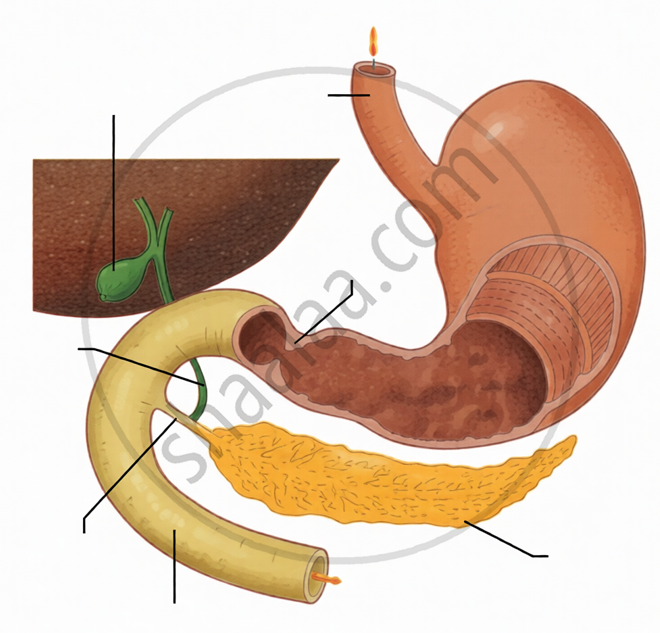
Label the diagram.
Given below is the outline of the human body showing the important glands:

- Name the glands marked 1 to 4.
- Name the hormone secreted by part 2. Give one important function of this hormone.
- Name the endocrine part of the numbered 3.
- Why is the part labelled 1 called the master gland? Which part of the forebrain controls the gland labelled 1?
- Name the gland that secretes the ‘emergency hormone’.
|
The diagram given below represents the location and structure of an endocrine gland. Study the same and answer the questions that follow:
|
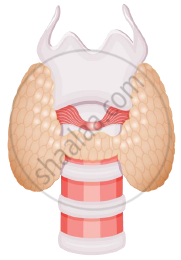
- Name the endocrine gland shown in the diagram.
- Name the secretion of the gland which regulates basal metabolism.
- Name the mineral element required for the synthesis of the above mentioned hormone.
- Name the disease caused due to undersecretion of the above mentioned hormone in children.
- Name the disease caused due to hypersecretion of the above mentioned hormone.
Match the items given in Column I with the most appropriate ones in Column II and rewrite the correct Matching pairs:
| Column I | Column II | ||
| (a) | Hyposecretion of Thyroxine in adults | 1. | Diabetes insipidus |
| (b) | Hyposecretion of Insulin | 2. | Myxedema |
| (c) | Hypersecretion of Growth Hormone in Childhood | 3. | Dwarfism |
| (d) | Hyposecretion of ADH | 4. | Gigantism |
| (e) | Hypersecretion of Thyroxine | 5. | Diabetes mellitus |
| 6. | Exophthalmic goitre | ||
| 7. | Cretinism | ||
Complete the table:
| Name of the Hormone | Endocrine Gland | Function |
| (i) | (ii) | Deposits extra glucose of blood as glycogen |
| Growth Hormone | (iii) | (iv) |
| (v) | Thyroid | (vi) |
| (vii) | (viii) | Prepare body for any emergencу |
| Oxytocin | (ix) | (x) |
Define the following term:
Hormones
Distinguish between diabetes mellitus and diabetes insipidus.
The diagram given below represents an endocrine gland in the human body. Study the diagram and answer the following questions:
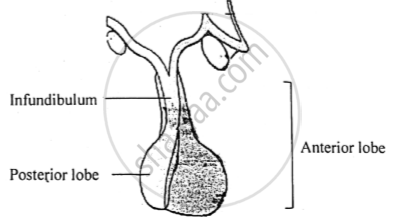
- Identify the endocrine gland. Where is it located?
- Why is the above gland referred to as the ‘Master gland’?
- Name the hormone which in deficiency causes Diabetes Insipidus. How does this disorder differ from Diabetes Mellitus?
- Explain the term ‘Hormone’. What is the role of Tropic hormones in the human body?
- Which lobe of the above gland secretes:
- Oxytocin
- ACTH
- Growth hormone
Solutions for 11: Endocrine System
Frank solutions for Biology Part 2 [English] Class 10 ICSE chapter 11 - Endocrine System
Shaalaa.com has the CISCE Mathematics Biology Part 2 [English] Class 10 ICSE CISCE solutions in a manner that help students grasp basic concepts better and faster. The detailed, step-by-step solutions will help you understand the concepts better and clarify any confusion. Frank solutions for Mathematics Biology Part 2 [English] Class 10 ICSE CISCE 11 (Endocrine System) include all questions with answers and detailed explanations. This will clear students' doubts about questions and improve their application skills while preparing for board exams.
Further, we at Shaalaa.com provide such solutions so students can prepare for written exams. Frank textbook solutions can be a core help for self-study and provide excellent self-help guidance for students.
Concepts covered in Biology Part 2 [English] Class 10 ICSE chapter 11 Endocrine System are Human Endocrine System, Adrenal Gland (Suprarenal Gland), Pancreas (Islets of Langerhans), Thyroid Gland, Pituitary Gland or Hypophysis Gland, Control of Hormonal Secretions, Hormonal Control Vs Nervous Control, Concept of Hormone, General Properties of Hormones, Summary of Hormones and Their Actions.
Using Frank Biology Part 2 [English] Class 10 ICSE solutions Endocrine System exercise by students is an easy way to prepare for the exams, as they involve solutions arranged chapter-wise and also page-wise. The questions involved in Frank Solutions are essential questions that can be asked in the final exam. Maximum CISCE Biology Part 2 [English] Class 10 ICSE students prefer Frank Textbook Solutions to score more in exams.
Get the free view of Chapter 11, Endocrine System Biology Part 2 [English] Class 10 ICSE additional questions for Mathematics Biology Part 2 [English] Class 10 ICSE CISCE, and you can use Shaalaa.com to keep it handy for your exam preparation.
