Please select a subject first
Advertisements
Advertisements
A given wire is stretched to double its length. How will its resistance change?
Concept: undefined >> undefined
State one factor on which a critical angle for a given pair of media depends. The critical angle for the glass-air interface is 45° for the yellow light. Will it be equal to, less than or greater than 45° for (i) red light, (ii) blue light?
Concept: undefined >> undefined
Advertisements
Name the factors affecting the critical angle for the pair of media.
Concept: undefined >> undefined
What is meant by the statement, ‘the critical angle for diamond is 24°’?
Concept: undefined >> undefined
How is the critical angle of a material related to its refractive index?
Concept: undefined >> undefined
What is meant by the term ‘critical angle’?
Concept: undefined >> undefined
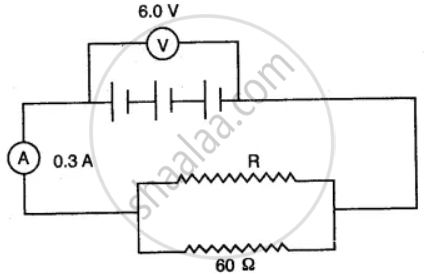
In the figure below, the ammeter A reads 0.3 A. Calculate:
(i) the total resistance of the circuit
(ii) the value of R
(iii) the current flowing through R.
Concept: undefined >> undefined
Calculate equivalent resistance in the following cases:
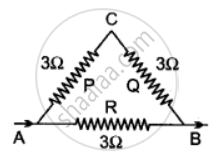
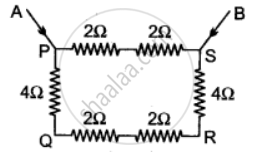
Concept: undefined >> undefined
Draw a diagram, properly labelled, to illustrate the use of a total reflecting prism (a right-angled isosceles prism) to turn a ray of light through 180°. Name an instrument in which this device is used.
Concept: undefined >> undefined
The diagram shows a point source P inside a water container. Three rays A, B, and C starting from P are shown up to the water surface. Show in the diagram the path of these rays after striking the water surface. The critical angle for the water-air pair is 48°.

Concept: undefined >> undefined
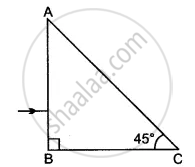
A ray of light passes through a right-angled prism as shown in the figure. State the angles of incidence at the faces AC and BC.
Concept: undefined >> undefined
The adjacent diagram shows two right-angled isosceles prisms A and B. Complete the diagram to show the path of rays P and Q emerging out of the prism B. What principles have you used to complete the diagram?

Concept: undefined >> undefined
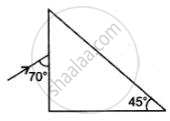
Complete the following diagram to show the path of the ray of a single colour in the diagram as if enters in and emerges out of the prism. Mark the angles wherever necessary. (Critical angle for glass = 42°).

Concept: undefined >> undefined
Complete the following diagram to show the path of the ray of a single colour in the diagram as if enters in and emerges out of the prism. Mark the angles wherever necessary. (Critical angle for glass = 42°).
Concept: undefined >> undefined
PQ and PR are two light rays emerging from the object as shown in the figure below:

(i) What is the special name given to the angle of incidence (∠PQN) of ray PQ?
(ii) Copy the ray diagram and complete it to show the position of the image of the object P when seen obliquely from above.
(iii) Name the phenomenon that occurs if the angle of incidence ∠PQN is increased still further.
Concept: undefined >> undefined
A ray of light is incident on a glass surface at an angle of 50° with the corresponding angle of refraction 30°. Find the value of the R.I. of glass.
Concept: undefined >> undefined
A ray of light is incident as a normal ray on the surface of separation of two different mediums. What is the value of the angle of incidence in this case?
Concept: undefined >> undefined
A flat coil of wire rotates at a constant speed about an axis perpendicular to a uniform magnetic field. Draw a graph to show how the induced e.m.f. varies relative to the positions of the coil during its one complete rotation. At what position of the coil, the e.m.f. has the maximum value?
Concept: undefined >> undefined
State change that you would make to convert an A.C. generator into a D.C. generator. Illustrate the change by a diagram.
Concept: undefined >> undefined
The given figures 1 to 3 show the working of a simple A.C. generator. Study the diagrams and answers of the following questions.
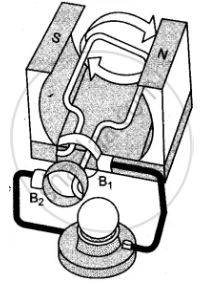
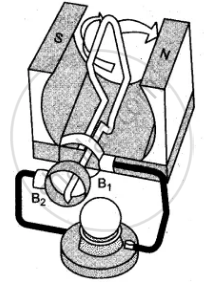
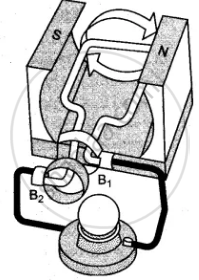
(i) State and explain the principle underlying the working of a simple generator.
(ii) Where is the loop of wire placed?
(iii) What happens when the loop is rotated?
(iv) Indicate the direction of the current flow through the wire for the first half of the turn (in first figure). Name and state the rule used in finding the direction of the current.
(v) Indicate the direction of the current for the case shown in second figure.
(vi) Indicate the direction of current in the outer circuit (i.e., electric bulb) in first and third figure.
(vii) What type of current is shown in the above diagrams? Explain.
Concept: undefined >> undefined
