Please select a subject first
Advertisements
Advertisements
Find the angles marked with a question mark shown in Fig. 17.27
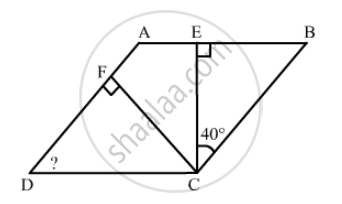
Concept: undefined >> undefined
Mohan purchased a house for Rs 30000 and its value is depreciating at the rate of 25% per year. Find the value of the house after 3 years.
Concept: undefined >> undefined
Advertisements
The value of a machine depreciates at the rate of 10% per annum. It was purchased 3 years ago. If its present value is Rs 43740, find its purchase price.
Concept: undefined >> undefined
The value of a refrigerator which was purchased 2 years ago, depreciates at 12% per annum. If its present value is Rs 9680, for how much was it purchased?
Concept: undefined >> undefined
The cost of a T.V. set was quoted Rs 17000 at the beginning of 1999. In the beginning of 2000 the price was hiked by 5%. Because of decrease in demand the cost was reduced by 4% in the beginning of 2001. What was the cost of the T.V. set in 2001?
Concept: undefined >> undefined
Ashish started the business with an initial investment of Rs 500000. In the first year he incurred a loss of 4%. However during the second year he earned a profit of 5% which in third year rose to 10%. Calculate the net profit for the entire period of 3 years.
Concept: undefined >> undefined
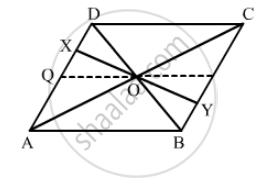
Diagonals of parallelogram ABCD intersect at O as shown in the following fegure. XY contains O, and X, Y are points on opposite sides of the parallelogram. Give reasons for each of the following:
(i) OB = OD
(ii) ∠OBY = ∠ODX
(iii) ∠BOY = ∠DOX
(iv) ∆BOY ≅ ∆DOX
Now, state if XY is bisected at O.
Concept: undefined >> undefined
In the following Figure ABCD is a arallelogram, CE bisects ∠C and AF bisects ∠A. In each of the following, if the statement is true, give a reason for the same:
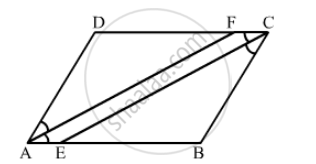
(i) ∠A = ∠C
(ii) \[\angle FAB = \frac{1}{2}\angle A\]
(iii) \[\angle DCE = \frac{1}{2}\angle C\]
(iv) \[\angle CEB = \angle FAB\]
(v) CE || AF
Concept: undefined >> undefined
Points E and F lie on diagonal AC of a parallelogram ABCD such that AE = CF. What type of quadrilateral is BFDE?
Concept: undefined >> undefined
In a parallelogram ABCD, AB = 10 cm, AD = 6 cm. The bisector of ∠A meets DC in E, AEand BC produced meet at F. Find te length CF.
Concept: undefined >> undefined
Which of the following statement is true for a rhombus?
It has two pairs of parallel sides.
Concept: undefined >> undefined
Which of the following statement is true for a rhombus?
It has two pairs of equal sides.
Concept: undefined >> undefined
Which of the following statement is true for a rhombus?
It has only two pairs of equal sides.
Concept: undefined >> undefined
Which of the following statement is true for a rhombus?
Two of its angles are at right angles
Concept: undefined >> undefined
Which of the following statement is true for a rhombus?
Its diagonals bisect each other at right angles.
Concept: undefined >> undefined
Which of the following statement is true for a rhombus?
Its diagonals are equal and perpendicular.
Concept: undefined >> undefined
Which of the following statement is true for a rhombus?
It has all its sides of equal lengths.
Concept: undefined >> undefined
Which of the following statement is true for a rhombus?
It is a parallelogram.
Concept: undefined >> undefined
Which of the following statement is true for a rhombus?
It is a quadrilateral.
Concept: undefined >> undefined
Which of the following statement is true for a rhombus?
It can be a square.
Concept: undefined >> undefined
