Advertisements
Advertisements
An I0m long uniform metallic wire having a resistance of 20Ω IS used as a potentiometer wire. This wire is connected in series with another resistance of 480Ω
and a battery of emf 5V having negligible internal resistance. If an unknown emf e is balanced across 6m of the potentiometer wire, calculate
1) the potential gradient across the potentiometer wire
2) the value of the unknown emf e.
Concept: Metre Bridge: Slide-Wire Bridge
In a potentiometer experiment, the balancing length with a resistance of 2Ω is found to be 100 cm, while that of an unknown resistance is 500 cm. Calculate the value of the unknown resistance.
Concept: Potentiometer
Obtain the balancing condition for the Wheatstone bridge arrangements as shown in Figure 4 below:
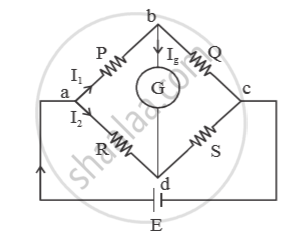
Concept: Wheatstone Bridge
What is meant by the drift speed of free electrons?
Concept: Ohm's Law
On which conservation principle is Kirchoff's Second Law of electrical networks based?
Concept: Kirchhoff’s Laws
Figure below shows two resistors R1 and R2 connected to a battery having an emf of 40V and negligible internal resistance. A voltmeter having a resistance of. 300 Ω is used to measure the potential difference across R1 Find the reading of the voltmeter.

Concept: Potentiometer
In the circuit shown in the figure below, E1 and E2 are two cells having emfs 2 V and 3 V respectively, and negligible internal resistance. Applying Kirchhoff’s laws of electrical networks, find the values of currents l1 and I2.

Concept: Kirchhoff’s Laws
Write balancing condition of a Wheatstone bridge.
Concept: Wheatstone Bridge
In the circuit shown in Figure below, E1 and E2 are batteries having emfs of 25V and 26V. They have an internal resistance of 1 Ω and 5 Ω respectively. Applying Kirchhoff’s laws of electrical networks, calculate the currents I1 and I2.

Concept: Kirchhoff’s Laws
A meter bridge is balanced with a known resistance (R) in the left hand gap and an unknown resistance (S) in the right hand gap. Balance point is found to be at a distance of 1 cm from the left hand side. When the battery and the galvanometer are interchanged, balance point will ______.
Concept: Metre Bridge: Slide-Wire Bridge
Three identical cells each of emf 'e' are connected in parallel to form a battery. What is the emf of the battery?
Concept: Potentiometer
The figure below shows two batteries, E1 and E2, having emfs of 18V and 10V and internal resistances of 1 Ω and 2 Ω, respectively. W1, W2 and W3 are uniform metallic wires AC, FD and BE having resistances of 8 Ω, 6 Ω and 10 Ω respectively. B and E are midpoints of the wires W1 and W2. Using Kirchhoff's laws of electrical circuits, calculate the current flowing in the wire W3:

Concept: Kirchhoff’s Laws
The Figure below shows a potentiometer circuit in which the driver cell D has an emf of 6 V and internal resistance of 2 Ω. The potentiometer wire AB is 10 m long and has a resistance of 28 Ω. The series resistance RS is of 2 Ω.

- The current Ip flowing in the potentiometer wire AB when the jockey (J) does not touch the wire AB.
- emf of the cell X if the balancing length AC is 4.5 m.
Concept: Potentiometer
In a potentiometer, a cell is balanced against 110 cm when the circuit is open. A cell is balanced at 100 cm when short-circuited through a resistance of 10 Ω. Find the internal resistance of the cell.
Concept: Potentiometer
How will you convert a moving coil galvanometer into a voltmeter?
Concept: Moving Coil Galvanometer
Why are the pole pieces of a horseshoe magnet in a moving coil galvanometer made cylinder in shape?
Concept: Moving Coil Galvanometer
A moving coil galvanometer has a coil of resistance 59 Ω. It shows a full-scale deflection for a current of 50 mA. How will you convert it to an ammeter having a range of 0 to 3A?
Concept: Moving Coil Galvanometer
Using Ampere's circuital law, obtain an expression for the magnetic flux density 'B' at a point 'X' at a perpendicular distance 'r' from a long current-carrying conductor.
(Statement of the law is not required).
Concept: Ampere’s Circuital Law
A moving coil galvanometer of resistance 55 Ω produces a full scale deflection for a current of 250 mA. How will you convert it into an ammeter with a range of 0 - 3A?
Concept: Moving Coil Galvanometer
Using Ampere’s circuital law, obtain an expression for magnetic flux density ‘B’ at a point near an infinitely long and straight conductor, carrying a current I.
Concept: Ampere’s Circuital Law
