Advertisements
Advertisements
Question
In a potentiometer, a cell is balanced against 110 cm when the circuit is open. A cell is balanced at 100 cm when short-circuited through a resistance of 10 Ω. Find the internal resistance of the cell.
Advertisements
Solution
r = `R (I_1/I_2 -1)`
= `10 (110/100 -1)`
= 1 Ω
APPEARS IN
RELATED QUESTIONS
Figure 3.34 shows a potentiometer circuit for comparison of two resistances. The balance point with a standard resistor R = 10.0 Ω is found to be 58.3 cm, while that with the unknown resistance X is 68.5 cm. Determine the value of X. What might you do if you failed to find a balance point with the given cell of emf ε?
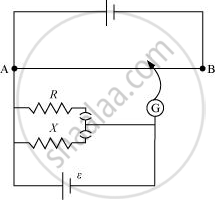
State the advantages of potentiometer over voltmeter.
A potentiometer wire has a length of 1.5 m and a resistance of 10 Ω. It is connected in series with the cell of emf 4 Volt and internal resistance 5 Ω. Calculate the potential drop per centimeter of the wire.
A potential drop per unit length along a wire is 5 × 10⁻³ V/m. If the emf of a cell balances against length 216 cm of this potentiometer wire, find the emf of the cell.
State any one use of a potentiometer.
To determine the internal resistance of a cell by using potentiometer, the null point is at 1 m when cell is shunted by 3 Ω resistance and at a length 1.5 m when cell is shunted by 6 Ω resistance. The internal resistance of the cell is ______.
If the length of potentiometer wire is increased, then the length of the previously obtained balance point will ______.
In a potentiometer experiment when three cells A, B, C are connected in series the balancing length is found to be 740 cm. If A and B are connected in series, the balancing length is 440 cm and when B and C are connected in series, it is 540 cm. The e.m.f. of A, B, and C cells EA, EB, EC are respectively (in volt) ______
The best instrument for accurate measurement of EMF of a cell is ____________.
Potential difference between the points A and B in the circuit shown is 16 V, then potential difference across 2Ω resistor is ______ V. volt. (VA > VB)

