Advertisements
Advertisements
प्रश्न
In a potentiometer, a cell is balanced against 110 cm when the circuit is open. A cell is balanced at 100 cm when short-circuited through a resistance of 10 Ω. Find the internal resistance of the cell.
Advertisements
उत्तर
r = `R (I_1/I_2 -1)`
= `10 (110/100 -1)`
= 1 Ω
APPEARS IN
संबंधित प्रश्न
A potentiometer wire has resistance of per unit length of 0.1 Ω/m. A cell of e.m.f. 1.5 V balances against a 300 cm length of the wire. Find the current in the potentiometer wire.
State the principle of working of a potentiometer.
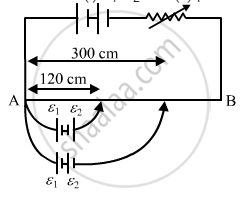
Figure shows a long potentiometer wire AB having a constant potential gradient. The null points for the two primary cells of emfs ε1 and ε2 connected in the manner shown are obtained at a distance of l1 = 120 cm and l2 = 300 cm from the end A. Determine (i) ε1/ε2 and (ii) position of null point for the cell ε1 only.
Draw a labelled circuit diagram of a potentiometer to compare emfs of two cells. Write the working formula (Derivation not required).
Which of the following is true for a potentiometer?
A potentiometer wire is 10 m long and has resistance of 2`Omega`/m. It is connected in series with a battery of e.m.f 3 V and a resistance of 10 `Omega`. The potential gradient along the wire in V/m is ______.
In the potentiometer experiment, cells of e.m.f. E1 and E2 are connected in series (E1 > E2). the balancing length is 64 cm of the wire. If the polarity of E2 is reversed, the balancing length becomes 32 cm. The ratio `E_1/E_2` is ______
A cell of internal resistance r is connected across an external resistance nr. Then the ratio of the terminal voltage to the emf of the cell is ______.
State dimension of potential gradient.
