Please select a subject first
Advertisements
Advertisements
What is ‘Ori’ ? State its importance during cloning of a vector.
Concept: Tools of Recombinant DNA Technology >> Cloning Vectors
Explain the importance of ‘Selectable marker’, with the help of a suitable example.
Concept: Tools of Recombinant DNA Technology >> Cloning Vectors
Why should a bacterium be made ‘competent’ ?
Concept: Tools of Recombinant DNA Technology >> Competent Host (For Transformation with Recombinant DNA)
Explain the role of ‘microinjection’ and ‘gene gun’ in biotechnology
Concept: Tools of Recombinant DNA Technology >> Competent Host (For Transformation with Recombinant DNA)
Answer the following question.
β galactosidase enzyme is considered a better selectable marker. Justify the statement.
Concept: Tools of Recombinant DNA Technology >> Cloning Vectors
Answer the following question.
Expand ‘YAC’ and mention what it was used for.
Concept: Tools of Recombinant DNA Technology >> Cloning Vectors
Answer the following question.
Explain the significance of palindromic nucleotide sequence in the formation of recombinant DNA.
Concept: Tools of Recombinant DNA Technology >> Restriction Enzymes
Answer the following question.
Write the use of restriction endonuclease in the formation of recombinant DNA.
Concept: Tools of Recombinant DNA Technology >> Restriction Enzymes
What is the cell that receives a recombinant gene called?
Concept: Principles of Processes of Biotechnology
Give a reason why :
Proteases are added during the isolation of DNA for genetic engineering.
Concept: Principles of Processes of Biotechnology
Give a reason why :
Single cloning site is preferred in a vector.
Concept: Tools of Recombinant DNA Technology >> Restriction Enzymes
How does the β-galactosidase coding sequence act as a selectable marker? Why is it a preferred selectable marker to antibiotic resistance genes? Explain.
Concept: Tools of Recombinant DNA Technology >> Cloning Vectors
In a pathological lab, a series of steps were undertaken for finding the gene of interest. Describe the steps, or make a flow chart showing the process of amplification of this gene of interest.
Concept: Processes of Recombinant DNA Technology
The figure below shows the structure of a plasmid.
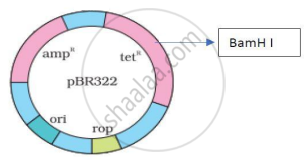
A foreign DNA was ligated at BamH1. The transformants were then grown in a medium containing antibiotics tetracycline and ampicillin.
Choose the correct observation for the growth of bacterial colonies from the given table.
Concept: Tools of Recombinant DNA Technology >> Cloning Vectors
CTTAAG
GAATTC
- What are such sequences called? Name the enzyme used that recognizes such nucleotide sequences.
- What is their significance in biotechnology?
Concept: Tools of Recombinant DNA Technology >> Restriction Enzymes
Carefully observe the given picture. A mixture of DNA with fragments ranging from 200 base pairs to 2500 base pairs was electrophoresed on agarose gel with the following arrangement.
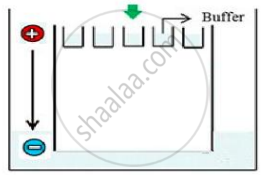
(a) What result will be obtained on staining with ethidium bromide? Explain with reason.
(b) The above setup was modified and a band with 250 base pairs was obtained at X.
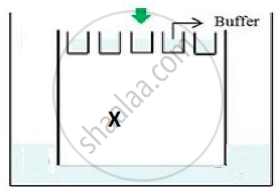
What change(s) were made to the previous design to obtain a band at X? Why did the band appear at position X?
Concept: Tools of Recombinant DNA Technology >> Restriction Enzymes
| Oil spill is a major environmental issue. It has been found that different strains of Pseudomonas bacteria have genes to break down the four major groups of hydrocarbons in oil. Trials are underway to use different biotechnological tools to incorporate these genes and create a genetically engineered strain of Pseudomonas - a ‘super-bug’, to break down the four major groups of hydrocarbons in oil. Such bacteria might be sprayed onto surfaces polluted with oil to clean thin films of oil. |
(a) List two advantages of using bacteria for such biotechnological studies?
(b) For amplification of the gene of interest PCR was carried out. The PCR was run with the help of polymerase which was functional only at a very low temperature. How will this impact the efficiency of the PCR? Justify.
(c) If such bacteria are sprayed on water bodies with oil spills, how will this have a positive or negative effect on the environment? Discuss.
Concept: Principles of Processes of Biotechnology
Non viral and non vector methods are sometimes used to transfer genes or alien DNA into a plant cell. Explain one such method used in genetic engineering.
Concept: Tools of Recombinant DNA Technology >> Competent Host (For Transformation with Recombinant DNA)
State the principle involved in separation of DNA fragments using gel electrophoresis.
Concept: Tools of Recombinant DNA Technology >> Restriction Enzymes
How are DNA fragments visualised once they are separated by gel electrophoresis?
Concept: Tools of Recombinant DNA Technology >> Restriction Enzymes
