Advertisements
Advertisements
Write two important advantages of reflecting telescope over a refracting telescope.
Concept: Introduction to Optical Instruments >> Telescope
Why are infra-red waves often called heat waves? Explain.
Concept: Electromagnetic Spectrum
Write the S.I. unit of mutual inductance.
Concept: Inductance >> Mutual Inductance
State the two Kirchhoff’s rules used in electric networks. How are there rules justified?
Concept: Kirchhoff’s Laws
State the two Kirchhoff’s rules used in electric networks. How are there rules justified?
Concept: Kirchhoff’s Laws
In a single slit diffraction experiment, the width of the slit is made double the original width. How does this affect the size and intensity of the central diffraction band?
Concept: Diffraction of Light >> The Single Slit
Four point charges Q, q, Q and q are placed at the corners of a square of side 'a' as shown in the figure.
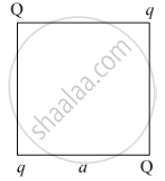
Find the
1) resultant electric force on a charge Q, and
2) potential energy of this system.
Concept: Potential Energy of a System of Charges
A 10 V cell of negligible internal resistance is connected in parallel across a battery of emf 200 V and internal resistance 38 Ω as shown in the figure. Find the value of current in the circuit.
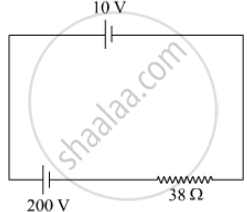
Concept: Cells, EMF, and Internal Resistance
State Ampere’s circuital law.
Concept: Ampere’s Circuital Law
The susceptibility of a magnetic material is 0·9853. Identify the type of magnetic material. Draw the modification of the field pattern on keeping a piece of this material in a uniform magnetic field.
Concept: Magnetic Properties of Materials
The teachers of Geeta’s school took the students on a study trip to a power generating station, located nearly 200 km away from the city. The teacher explained that electrical energy is transmitted over such a long distance to their city, in the form of alternating current (ac) raised to a high voltage. At the receiving end in the city, the voltage is reduced to operate the devices. As a result, the power loss is reduced. Geeta listened to the teacher and asked questions about how the ac is converted to a higher or lower voltage.
1) Name the device used to change the alternating voltage to a higher or lower value. State one cause for power dissipation in this device.
2) Explain with an example, how power loss is reduced if the energy is transmitted over long distances as an alternating current rather than a direct current.
3) Write two values each shown by the teachers and Geeta.
Concept: Transformers
Name the electromagnetic radiations used for (a) water purification, and (b) eye surgery.
Concept: Electromagnetic Spectrum
The figure shows a ray of light falling normally on the face AB of an equilateral glass prism having refractive index`3/2`, placed in water of refractive index `4/3`.Will this ray suffer total internal reflection on striking the face AC? Justify your answer.
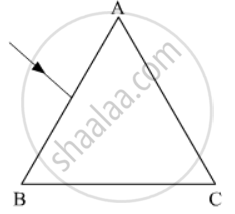
Concept: Total Internal Reflection
When a tiny circular obstacle is placed in the path of light from a distant source, a bright spot is seen at the centre of the shadow of the obstacle. Explain why?
Concept: Coherent and Incoherent Addition of Waves
If one of two identical slits producing interference in Young’s experiment is covered with glass, so that the light intensity passing through it is reduced to 50%, find the ratio of the maximum and minimum intensity of the fringe in the interference pattern.
Concept: Interference of Light Waves and Young’s Experiment
Using Huygens’ principle, verify the laws of reflection at a plane surface.
Concept: Huygens Principle
If light of wavelength 412.5 nm is incident on each of the metals given below, which ones will show photoelectric emission and why?
| Metal | Work Function (eV) |
| Na | 1.92 |
| K | 2.15 |
| Ca | 3.20 |
| Mo | 4.17 |
Concept: Photoelectric Effect and Wave Theory of Light
