Advertisements
Advertisements
Question
If light of wavelength 412.5 nm is incident on each of the metals given below, which ones will show photoelectric emission and why?
| Metal | Work Function (eV) |
| Na | 1.92 |
| K | 2.15 |
| Ca | 3.20 |
| Mo | 4.17 |
Advertisements
Solution
Energy of a photon of the given light is, E = `1240/lambda = 3 ev`
Thus, metals having work-function less than energy of photon of falling light will show photoelectric effect. So, Na and K will show photoelectric effect.
APPEARS IN
RELATED QUESTIONS
Is the formula you employ in (a) valid for calculating radius of the path of a 20 MeV electron beam? If not, in what way is it modified?
An electron gun with its collector at a potential of 100 V fires out electrons in a spherical bulb containing hydrogen gas at low pressure (∼10−2 mm of Hg). A magnetic field of 2.83 × 10⁻⁴ T curves the path of the electrons in a circular orbit of radius 12.0 cm. (The path can be viewed because the gas ions in the path focus the beam by attracting electrons, and emitting light by electron capture; this method is known as the ‘fine beam tube’ method. Determine e/m from the data.
In the arrangement shown in the figure, y = 1.0 mm, d = 0.24 mm and D = 1.2 m. The work function of the material of the emitter is 2.2 eV. Find the stopping potential V needed to stop the photocurrent.
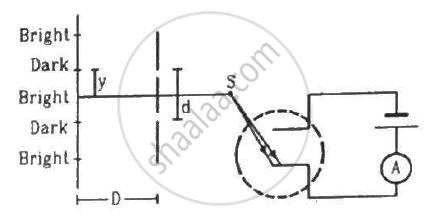
(Use h = 6.63 × 10⁻³⁴J-s = 4.14 × 10⁻¹⁵ eV-s, c = 3 × 10⁸ m/s and me = 9.1 × 10⁻³¹kg)
In Photoelectric effect ______.
By when was the wave nature of light well established?
Which phenomena were explained in a natural and satisfactory way by the wave picture of light?
How should the maximum kinetic energy of photoelectrons change with increasing intensity, according to wave theory?
What does wave theory predict about the existence of a threshold frequency?
Why does the energy absorbed by each electron per unit time become very small in the wave picture?
What is observed about the timing of photoelectric emission?
