Advertisements
Advertisements
Question
Define the term "cut off frequency" in photoelectric emission. The threshod frequency of a metal is f. When the light of frequency 2f is incident on the metal plate, the maximum velocity of photo-electrons is v1. When the frequency of the incident radiation is increased to 5f, the maximum velocity of phto-electrons is v2. Find the ratio v1 : v2.
Advertisements
Solution
That particular frequency of incident radiation for which the minimum negative potential V0 given to a plate for photelectric current becomes zero is called the cut-off frequency.
Given that threshold frequency of metal is f. For light of frequency 2f, using Einstein's equation for photoelectric effect, we can write
\[h\left( 2f - f \right) = \frac{1}{2}m {v_1}^2\] .......... (1)
Similarly, for light having frequency 5f, we have
\[\frac{f}{4f} = \frac{{v_1}^2}{{v_2}^2} \Rightarrow \frac{v_1}{v_2} = \sqrt{\frac{1}{4}}\]
\[ \Rightarrow \frac{v_1}{v_2} = \frac{1}{2}\]
APPEARS IN
RELATED QUESTIONS
Is the formula you employ in (a) valid for calculating radius of the path of a 20 MeV electron beam? If not, in what way is it modified?
In an experiment on photoelectric effect, light of wavelength 400 nm is incident on a cesium plate at the rate of 5.0 W. The potential of the collector plate is made sufficiently positive with respect to the emitter, so that the current reaches its saturation value. Assuming that on average, one out of every 106 photons is able to eject a photoelectron, find the photocurrent in the circuit.
A horizontal cesium plate (φ = 1.9 eV) is moved vertically downward at a constant speed v in a room full of radiation of wavelength 250 nm and above. What should be the minimum value of v so that the vertically-upward component of velocity is non-positive for each photoelectron?
(Use h = 6.63 × 10⁻³⁴J-s = 4.14 × 10⁻¹⁵ eV-s, c = 3 × 10⁸ m/s and me = 9.1 × 10⁻³¹kg)
In the arrangement shown in the figure, y = 1.0 mm, d = 0.24 mm and D = 1.2 m. The work function of the material of the emitter is 2.2 eV. Find the stopping potential V needed to stop the photocurrent.
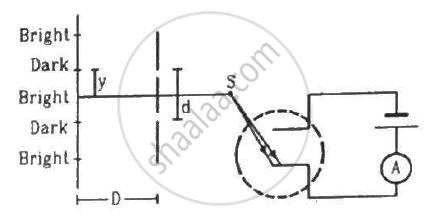
(Use h = 6.63 × 10⁻³⁴J-s = 4.14 × 10⁻¹⁵ eV-s, c = 3 × 10⁸ m/s and me = 9.1 × 10⁻³¹kg)
Plot a graph to show the variation of stopping potential with frequency of incident radiation in relation to photoelectric effect.
In the case of a photo electric effect experiment, explain the following facts, giving reasons.
The wave theory of light could not explain the existence of the threshold frequency.
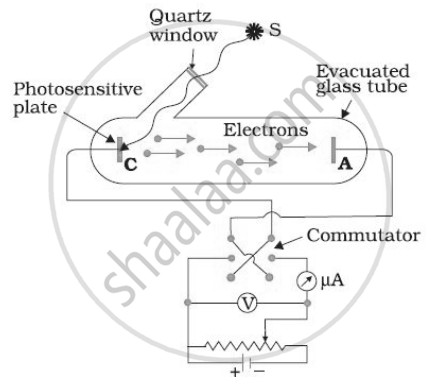
For a given frequency of light and a positive plate potential in the set up below, If the intensity of light is increased then ______.
Which phenomena were explained in a natural and satisfactory way by the wave picture of light?
According to the wave picture, what is light?
What does wave theory predict about the existence of a threshold frequency?
