Advertisements
Advertisements
Question
A silver ball of radius 4.8 cm is suspended by a thread in a vacuum chamber. Ultraviolet light of wavelength 200 nm is incident on the ball for some time during which light energy of 1.0 × 10⁻⁷ J falls on the surface. Assuming that on average, one photon out of every ten thousand is able to eject a photoelectron, find the electric potential at the surface of the ball, assuming zero potential at infinity. What is the potential at the centre of the ball?
(Use h = 6.63 × 10⁻³⁴J-s = 4.14 × 10⁻¹⁵ eV-s, c = 3 × 10⁸ m/s and me = 9.1 × 10⁻³¹kg)
Advertisements
Solution
Given:-
Radius of the silver ball, r = 4.8 cm
Wavelength of the ultra violet light, λ = 200 nm = 2 × 10⁻⁷ m
Total energy of light, E = 1.0 × 10⁻⁷ J
We are given that one photon out of every ten thousand is able to eject a photoelectron.
Energy of one photon,
`E^' = (hc)/lambda`,
where h = Planck's constant
c = speed of light
`lambda` = wavelength of light
On substituting the respective values in the above formula, we get :
`E^' = (6.63 xx 10^-34 xx 3 xx 10^8)/(2 xx 10^-7)`
`=9.945 xx 10^-19`
Number of photons,
`n = E/E^' = (1 xx 10^-7)/(9.945 xx 10^-19) = 1 xx 10^11`
Number of photoelectrons
= `(1 xx 10^11)/10^4 = 1 xx 10^7`
The amount of positive charge developed due to the outgoing electrons,
`q = 1 xx 10^7 xx 1.6 xx 10^-19`
`= 1.6 xx 10^-12 C`
Potential developed at the centre as well as on surface,
`V = (Kq)/r`,
where K = `1/(4piε_0)`
`therefore V = (9 xx 10^9 xx 1.6 xx 10^-12)/(4.8 xx 10^-2) = 0.3 V`
Potential inside the silver ball remains constant. Therefore, potential at the centre of the sphere is 0.3 V.
APPEARS IN
RELATED QUESTIONS
Is the formula you employ in (a) valid for calculating radius of the path of a 20 MeV electron beam? If not, in what way is it modified?
What is so special about the combination e/m? Why do we not simply talk of e and m separately?
Define the term "cut off frequency" in photoelectric emission. The threshod frequency of a metal is f. When the light of frequency 2f is incident on the metal plate, the maximum velocity of photo-electrons is v1. When the frequency of the incident radiation is increased to 5f, the maximum velocity of phto-electrons is v2. Find the ratio v1 : v2.
Visible light has wavelengths in the range of 400 nm to 780 nm. Calculate the range of energy of the photons of visible light.
(Use h = 6.63 × 10⁻³⁴J-s = 4.14 × 10⁻¹⁵ eV-s, c = 3 × 10⁸ m/s and me = 9.1 × 10⁻³¹kg)
Two neutral particles are kept 1 m apart. Suppose by some mechanism some charge is transferred from one particle to the other and the electric potential energy lost is completely converted into a photon. Calculate the longest and the next smaller wavelength of the photon possible.
(Use h = 6.63 × 10⁻³⁴J-s = 4.14 × 10⁻¹⁵ eV-s, c = 3 × 10⁸ m/s and me = 9.1 × 10⁻³¹kg)
A light beam of wavelength 400 nm is incident on a metal plate of work function 2.2 eV. (a) A particular electron absorbs a photon and makes two collisions before coming out of the metal. Assuming that 10% of the extra energy is lost to the metal in each collision, find the kinetic energy of this electron as it comes out of the metal. (b) Under the same assumptions, find the maximum number of collisions the electron can suffer before it becomes unable to come out of the metal.
A horizontal cesium plate (φ = 1.9 eV) is moved vertically downward at a constant speed v in a room full of radiation of wavelength 250 nm and above. What should be the minimum value of v so that the vertically-upward component of velocity is non-positive for each photoelectron?
(Use h = 6.63 × 10⁻³⁴J-s = 4.14 × 10⁻¹⁵ eV-s, c = 3 × 10⁸ m/s and me = 9.1 × 10⁻³¹kg)
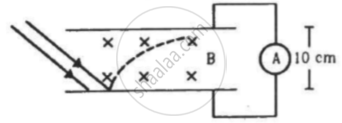
In an experiment on photoelectric effect, the emitter and the collector plates are placed at a separation of 10 cm and are connected through an ammeter without any cell. A magnetic field B exists parallel to the plates. The work function of the emitter is 2.39 eV and the light incident on it has wavelengths between 400 nm and 600 nm. Find the minimum value of B for which the current registered by the ammeter is zero. Neglect any effect of space charge.
Plot a graph to show the variation of stopping potential with frequency of incident radiation in relation to photoelectric effect.
The electromagnetic theory of light failed to explain ______.
In photoelectric effect, the photoelectric current
An increase in the intensity of the radiation causing photo-electric emission from a surface does not affect the maximum K.E. of the photoelectrons. Explain.
Which phenomena were explained in a natural and satisfactory way by the wave picture of light?
How should the maximum kinetic energy of photoelectrons change with increasing intensity, according to wave theory?
What does wave theory predict about the existence of a threshold frequency?
Which wave-theory prediction about maximum kinetic energy contradicts the observed features of photoelectric emission?
What energy must an electron gain to escape from the metal?
What is observed about the timing of photoelectric emission?
