Advertisements
Advertisements
Question
An electron gun with its collector at a potential of 100 V fires out electrons in a spherical bulb containing hydrogen gas at low pressure (∼10−2 mm of Hg). A magnetic field of 2.83 × 10⁻⁴ T curves the path of the electrons in a circular orbit of radius 12.0 cm. (The path can be viewed because the gas ions in the path focus the beam by attracting electrons, and emitting light by electron capture; this method is known as the ‘fine beam tube’ method. Determine e/m from the data.
Advertisements
Solution
Potential of an anode, V = 100 V
Magnetic field experienced by the electrons, B = 2.83 × 10⁻⁴ T
Radius of the circular orbit r = 12.0 cm = 12.0 × 10⁻² m
Mass of each electron = m
Charge on each electron = e
Velocity of each electron = v
The energy of each electron is equal to its kinetic energy, i.e.,
`1/2 "mv"^2 = "eV"`
`"v"^2 = (2"eV")/"m"` ..............(1)
It is the magnetic field, due to its bending nature, that provides the centripetal force
`("F" = "mv"^2/"r")` for the beam. Hence, we can write:
Centripetal force = Magnetic force
`"mv"^2/"r" = "evB"`
`"eB" = "mv"/"r"`
`"v" = ("eBr")/"m"` ..............(2)
Putting the value of v in equation (1), we get:
`(2"eV")/"m" = ("e"^2"B"^2"r"^2)/"m"^2`
`"e"/"m" = "2V"/("B"^2"r"^2)`
= `(2 xx 100)/((2.83 xx 10^(-4))^2 xx (12 xx 10^(-2))^2)`
= 1.73 × 10¹¹ C kg−1
Therefore, the specific charge ratio (e/m) is 1.73 × 10¹¹ C kg−1.
APPEARS IN
RELATED QUESTIONS
If light of wavelength 412.5 nm is incident on each of the metals given below, which ones will show photoelectric emission and why?
| Metal | Work Function (eV) |
| Na | 1.92 |
| K | 2.15 |
| Ca | 3.20 |
| Mo | 4.17 |
Visible light has wavelengths in the range of 400 nm to 780 nm. Calculate the range of energy of the photons of visible light.
(Use h = 6.63 × 10⁻³⁴J-s = 4.14 × 10⁻¹⁵ eV-s, c = 3 × 10⁸ m/s and me = 9.1 × 10⁻³¹kg)
Two neutral particles are kept 1 m apart. Suppose by some mechanism some charge is transferred from one particle to the other and the electric potential energy lost is completely converted into a photon. Calculate the longest and the next smaller wavelength of the photon possible.
(Use h = 6.63 × 10⁻³⁴J-s = 4.14 × 10⁻¹⁵ eV-s, c = 3 × 10⁸ m/s and me = 9.1 × 10⁻³¹kg)
In an experiment on photoelectric effect, light of wavelength 400 nm is incident on a cesium plate at the rate of 5.0 W. The potential of the collector plate is made sufficiently positive with respect to the emitter, so that the current reaches its saturation value. Assuming that on average, one out of every 106 photons is able to eject a photoelectron, find the photocurrent in the circuit.
A light beam of wavelength 400 nm is incident on a metal plate of work function 2.2 eV. (a) A particular electron absorbs a photon and makes two collisions before coming out of the metal. Assuming that 10% of the extra energy is lost to the metal in each collision, find the kinetic energy of this electron as it comes out of the metal. (b) Under the same assumptions, find the maximum number of collisions the electron can suffer before it becomes unable to come out of the metal.
In the arrangement shown in the figure, y = 1.0 mm, d = 0.24 mm and D = 1.2 m. The work function of the material of the emitter is 2.2 eV. Find the stopping potential V needed to stop the photocurrent.
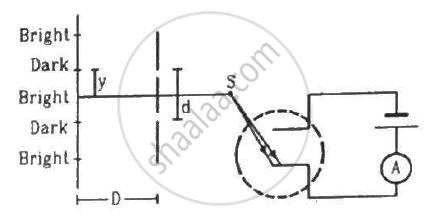
(Use h = 6.63 × 10⁻³⁴J-s = 4.14 × 10⁻¹⁵ eV-s, c = 3 × 10⁸ m/s and me = 9.1 × 10⁻³¹kg)
The stopping potential in an experiment on photoelectric effect is 1.5V. What is the maximum kinetic energy of the photoelectrons emitted? Calculate in Joules.
Answer the following question.
Why is the wave theory of electromagnetic radiation not able to explain the photoelectric effect? How does a photon picture resolve this problem?
In the experimental set up for studying photoelectric effect, if keeping the frequency of the incident radiation and the accelerating potential fixed, the intensity of light is varied, then ______.

The electromagnetic theory of light failed to explain ______.
In photoelectric effect, the photoelectric current
By when was the wave nature of light well established?
According to the wave picture, what is light?
What do free electrons at the surface of a metal do when radiation falls on the surface, according to the wave picture?
According to wave theory, how should greater radiation intensity affect the energy absorbed by each electron?
What energy must an electron gain to escape from the metal?
