Science (English Medium)
Academic Year: 2025-2026
Date & Time: 27th March 2026, 10:30 am
Duration: 3h
Advertisements
Note:
- Please check that this question paper contains 23 printed pages.
- Q.P. Code given on the right hand side of the question paper should be written on the title page of the answer-book by the candidate.
- Please check that this question paper contains 33 questions.
- Please write down the Serial Number of the question in the answer-book at the given place before attempting it.
- 15 minute time has been allotted to read this question paper. The question paper will be distributed at 10.15 a.m. From 10.15 a.m. to 10.30 a.m, the candidates will read the question paper only and will not write any answer on the answer-book during this period.
General Instructions:
Read the following instructions very carefully and strictly follow them:
- This question paper contains 33 questions. All questions are compulsory.
- Question paper is divided into five sections – Sections A, B, C, D, and E.
- Section A – questions number 1 to 16 are Multiple Choice Type questions. Each question carries 1 mark.
- Section B – questions number 17 to 21 are Very Short Answer Type questions. Each question carries 2 marks.
- Section C – questions number 22 to 28 are Short Answer Type questions. Each question carries 3 marks.
- Section D – questions number 29 and 30 are Case-Based questions. Each question carries 4 marks. Each question has subparts with internal choice in one of the subparts.
- Section E – questions number 31 to 33 are Long Answer Type questions. Each question carries 5 marks.
The foetal ejection reflex in humans triggers the release of ______ hormone from ______.
oxytocin, foetal pituitary
oxytocin, maternal pituitary
human chorionic gonadotropin, placenta
progesterone, corpus luteum
Chapter:
Match the IUDs in Column I with suitable example in Column II.
| Column I | Column II | ||
| a. | Non-medicated | i. | Lippes loop |
| b. | Copper releasing | ii. | LNG-20 |
| c. | Hormone releasing | iii. | Multiload 375 |
a - iii, b - ii, c - i
a - i, b - ii, c - iii
a - i, b - iii, c - ii
a - ii, b - i, c - iii
Chapter:
In Pisum sativum, the flower colour may be violet (V) or white (v). What proportion of the offspring in a cross of “VV × vv” would be expected to be violet?
25%
50%
75%
100%
Chapter:
Arrange the following in the correct sequence of their evolution and select the correct option:
- Seaweed
- Invertebrates
- Jawless fish
(i), (ii), (iii)
(i), (iii), (ii)
(ii), (iii), (i)
(ii), (i), (iii)
Chapter:
If a genetic disease is transferred from a phenotypically normal but carrier female to only some of the male progeny, the disease is ______.
Sex-linked recessive
Autosomal dominant
Sex-linked dominant
Autosomal recessive
Chapter:
A DNA molecule is 160 base pairs long. It has 30% Guanine. How many Adenine bases are present in this DNA molecule?
48
64
96
192
Chapter:
A doctor identifies symptoms of nasal congestion, headache, sore throat, hoarseness, and cough in a patient. The conclusion is that the patient is infected by a pathogen ______.
Plasmodium
Adenovirus
Salmonella
Rhinovirus
Chapter:
Which type of selection is industrial melanism observed in moth, Biston betularia?
Stabilising
Directional
Disruptive
Artificial
Chapter:
C-peptide of human insulin is ______.
A part of mature insulin molecule
Responsible for the formation of disulphide bridges
Removed during maturation of pro-insulin to insulin
Responsible for its biological activity.
Chapter: [10] Biotechnology and Its Application
Given below is the restriction site of a restriction endonuclease Pst-I and the cleavage sites on a DNA molecule.
\[\ce{5' C - T - G - C - A \overset{\downarrow}{-}{G 3'}}\]
\[\ce{3' G\underset{\uparrow}{-} A - C - G - T - C 5'}\]
Choose the option that gives the correct resultant fragments by the action of the enzyme Pst-I.
| 5' C - T - G | C - A - G 3' |
| 3' G - A - C - G - T | C 5' |
| 5' C - T | G - C - A - G 3' |
| 3' G - A - G - C | T - C 5' |
| 5' C - T - G - C | A - G 3' |
| 3' G - A - C - G | T - C 5' |
| 5' C - T - G - C - A | G 3' |
| 3' G | A - C - G - T - C 5' |
Chapter: [9] Biotechnology - Principles and Processes
Which of the following fish led to the extinction of an ecologically unique assemblage of more than 200 species of cichlid fish in Lake Victoria of East Africa?
Catla Catla
Dogfish
Nile Perch
African Catfish
Chapter:
Cattle or goats are never seen browsing on the weed, Calotropis. Select the correct option for the reason.
The plant produces highly poisonous tannins.
The plant produces quinine, which is bitter in taste.
The plant produces the poisonous chemical, cardiac glycoside.
The plant bears prickles.
Chapter:
Assertion (A): Repetitive sequences make up a very large portion of the human genome.
Reason (R): Repetitive sequences do not have direct coding functions in the genome.
Both Assertion (A) and Reason (R) are true and Reason (R) is the correct explanation of the Assertion (A).
Both Assertion (A) and Reason (R) are true, but Reason (R) is not the correct explanation of the Assertion (A).
Assertion (A) is true, but Reason (R) is false.
Assertion (A) is false, but Reason (R) is true.
Chapter:
Assertion (A): The embryo with 8 to 16 blastomeres is called a morula.
Reason (R): The morula continues to divide and transform into trophoblast.
Both Assertion (A) and Reason (R) are true and Reason (R) is the correct explanation of the Assertion (A).
Both Assertion (A) and Reason (R) are true, but Reason (R) is not the correct explanation of the Assertion (A).
Assertion (A) is true, but Reason (R) is false.
Assertion (A) is false, but Reason (R) is true.
Chapter:
Assertion (A): The use of chitinase enzyme is necessary for the separation of DNA from yeast cells but not in the case of Spirogyra.
Reason (R): Fungal cell wall is made up of fungal chitin.
Both Assertion (A) and Reason (R) are true and Reason (R) is the correct explanation of the Assertion (A).
Both Assertion (A) and Reason (R) are true, but Reason (R) is not the correct explanation of the Assertion (A).
Assertion (A) is true, but Reason (R) is false.
Assertion (A) is false, but Reason (R) is true.
Chapter:
Assertion (A): Besides curdling of milk, LAB also improves its nutritional quality by increasing Vitamin B12.
Reason (R): LAB, when present in the stomach, checks disease-causing microbes.
Both Assertion (A) and Reason (R) are true and Reason (R) is the correct explanation of the Assertion (A).
Both Assertion (A) and Reason (R) are true, but Reason (R) is not the correct explanation of the Assertion (A).
Assertion (A) is true, but Reason (R) is false.
Assertion (A) is false, but Reason (R) is true.
Chapter:
State the role of the thymus as a lymphoid organ. Name the cells that are released from it and mention their function.
Chapter: [7] Human Health and Diseases
Explain the mutually rewarding relationship between Yucca plant and species of moth.
Chapter:
Pollination success will be reduced unless the orchid flower co-evolves with the pollinator. Explain.
Chapter:
Advertisements
Differentiate between grazing food chain and detritus food chain.
Chapter:
Write any two limitations of ecological pyramids.
Chapter: [12] Ecosystem
How do ‘implants’ act as an effective method of contraception in human females?
Chapter:
Mention one advantage of implants over contraceptive pills.
Chapter:
Explain any two methods of vectorless gene transfer.
Chapter:
Name two commonly used bioreactors.
Chapter: [9] Biotechnology - Principles and Processes
Draw a labelled diagram of a “replicating fork” showing the polarity.
Chapter:
Why does DNA replication occur within ‘replicating fork’?
Chapter:
Make a list of any three outbreeding devices that flowering plants have developed and explain how they help to encourage cross-pollination.
Chapter: [1] Sexual Reproduction in Flowering Plants
Explain how the following microbe act as biocontrol agent:
Bacillus thuringiensis
Chapter:
Explain how the following microbe act as biocontrol agent:
Nucleopolyhedrovirus
Chapter:
Transgenic animals are produced by man. Explain any three ways in which such animals can be beneficial to humans.
Chapter:
Explain the level of biodiversity at genetic level with the help of one example.
Chapter:
Explain the level of biodiversity at species level with the help of one example.
Chapter:
Explain the level of biodiversity at ecological level with the help of one example.
Chapter:
Study the given chart showing the evolution of plants. Answer the following questions:
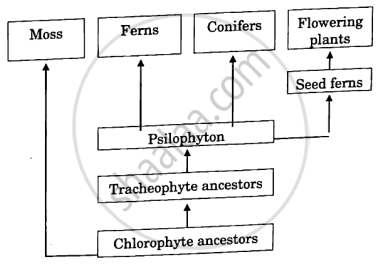
- Identify the plant which acts as an immediate ancestor of both ferns and conifers.
- Name the nearest ancestors of flowering plants.
- Name the most primitive group of plants.
- Psilophytan provides common ancestry to which classes?
- Name the common ancestor of psilophytan and seed ferns.
- Name the common ancestor of mosses and tracheophytes.
Chapter:
Advertisements
Given below is an equation describing the growth pattern of a population:
dN/dt = rN
- Mention the type of growth model or growth pattern of the population described by the given equation.
- What does ‘r’ in the equation signify?
- Mention the type of growth curve that will be obtained if the population density (N) is plotted against time (t).
- According to you, will the resource availability be limited or unlimited for this type of growth in the given population?
Chapter:
Read the following passage and answer the questions that follow:
| The process of copying genetic information from the template strand of DNA into RNA is called transcription. It is mediated by RNA polymerase. Transcription takes place in the nucleus of eukaryotic cells. In transcription, only a segment of DNA and only one of the strands is copied into RNA. |
- Why is the strand of DNA with 3' → 5' polarity transcribed and not the other strand of 5' → 3' polarity? [1]
- Why is hnRNA required to undergo splicing? [1]
OR - Mention the two additional processes which hnRNA needs to undergo after splicing to become functional. [1]
- Why is only one strand of the DNA transcribed? Give two reasons. [2]
Chapter:
Read the following passage and answer the questions that follow:
| We know that plasmids and bacteriophages are the most commonly used vectors in biotechnology experiments. If we can link an alien piece of DNA to the plasmid DNA, the alien DNA can be multiplied equal to the copy number of the plasmid. Engineered vectors are used these days. |
Study the diagram of the E. coli cloning vector pBR322 and answer the questions that follow:
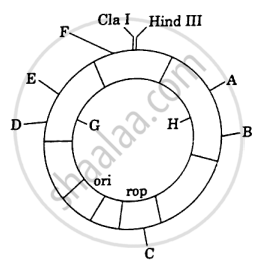
(a) Why are plasmids and bacteriophages used as cloning vectors? [1]
(b) (i) Identify: [1]
- The gene in the cloning vector that controls the copy number of the vector.
- The restriction site - C in the ‘rop’ gene.
OR
(b) (ii) Identify and name two selectable markers shown in the diagram. [1]
(c) Name the two restriction sites each in the two genes you have identified as selectable markers. [2]
Chapter:
Work out separate monohybrid crosses up to F2 generation between two pea plants and two Antirrhinum plants, both having contrasting traits with respect to the colour of the flower. Comment on the patterns of inheritance in the crosses carried out in such two cases.
Chapter:
How does a chromosomal disorder differ from a Mendelian disorder? Write one example for each.
Chapter:
Name the phenomenon that leads to situations like ‘XO’ abnormality in humans. Also name this genetic disorder. How are individuals with an XO chromosomal abnormality affected? Write its symptoms as well as karyotype.
Chapter:
Differentiate between
Active and passive immunity
Chapter:
- Write the scientific names of the two species of filarial worms causing filariasis. [1]
- How do they affect the body of infected persons? [1]
- How does the disease spread? [1]
Chapter:
Mention the source and the role of the following in providing defence against infection in the human body:
Histamine
Chapter:
Mention the source and the role of the following in providing defence against infection in the human body:
Interferons
Chapter:
Briefly explain the events of fertilisation and implantation in an adult human female.
Chapter:
Arrange the following hormones in sequence of their secretion in a pregnant woman.
hCG, LH, FSH, Relaxin
Chapter: [2] Human Reproduction
Mention the source and function of hCG hormone.
Chapter:
Mention the source and function of the LH hormone.
Chapter:
Mention the source and function of the FSH hormone.
Chapter:
Mention the source and function of the relaxin hormone.
Chapter:
Other Solutions
Submit Question Paper
Help us maintain new question papers on Shaalaa.com, so we can continue to help studentsonly jpg, png and pdf files
CBSE previous year question papers Class 12 Biology with solutions 2025 - 2026
Previous year Question paper for CBSE Class 12 -2026 is solved by experts. Solved question papers gives you the chance to check yourself after your mock test.
By referring the question paper Solutions for Biology, you can scale your preparation level and work on your weak areas. It will also help the candidates in developing the time-management skills. Practice makes perfect, and there is no better way to practice than to attempt previous year question paper solutions of CBSE Class 12.
How CBSE Class 12 Question Paper solutions Help Students ?
• Question paper solutions for Biology will helps students to prepare for exam.
• Question paper with answer will boost students confidence in exam time and also give you an idea About the important questions and topics to be prepared for the board exam.
• For finding solution of question papers no need to refer so multiple sources like textbook or guides.
