Advertisements
Advertisements
Questions
Make a list of any three outbreeding devices that flowering plants have developed and explain how they help to encourage cross-pollination.
List any three outbreeding devices that flowering plants have developed for cross-pollination and explain how they help to encourage cross-pollination.
Advertisements
Solution
- Dichogamy: Flowers are unisexual, so self-pollination is not possible. The plants may be monoecious, bearing both male and female flowers (e.g. maize), or dioecious, bearing male and female flowers on separate plants (e.g. mulberry, papaya).
- Prepotency: Pollen grains of another flower germinate more rapidly on the stigma than pollen grains of the same flower. Examples of this include apples and grapes.
- Self-sterility (Self-incompatibility): Pollen grains of a flower do not germinate on the stigma of the same flower because of the presence of similar self-sterile genes. Examples of this include tobacco, potatoes, and crucifers.
APPEARS IN
RELATED QUESTIONS
Mention two strategies that evolved to prevent self-pollination in flowers.
Add a note on pollination mechanism in Salvia.
Name two characteristics of flowers in which pollination occur by wind.
State the name of the chief pollinating agent against the corresponding plant by choosing from those given in brackets.
Dahlia_______ .
Name of the part of the ovary which gives rise to:
Fruit ______
Give one word/term for the following:
Pollination of flowers by birds.
Can a plant flowering in Mumbai be pollinated by pollen grains of the same species growing in New Delhi? Provide explanations to your answer.
What are the adaptations which are required in self-pollinated plants?
Explain water pollination in detail with its types.
Wind pollination is common in ______.
A particular species of plant produces light, non-sticky pollen in large numbers and its stigmas are long and feathery. These modifications facilitate pollination by ______.
Anemophily type of pollination is found in ______.
Male and female flowers are present on different plants (dioecious) to ensure xenogamy, in ______.
Which of these is a condition that makes flowers invariably autogamous?
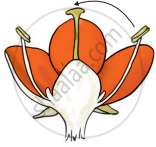
Which type of pollination does the figure indicate?
The term used for transfer of pollen grains from anthers of one plant to stigma of a different plant which, during pollination, brings genetically different types of pollen grains to stigma, is ______
Pollination in water lilies is carried out by ______.
In sea grass, pollens are long, ribbon like and without exine exhibiting ______ pollination.
Which type of pollination involves the transfer of pollen between different plants of the same species?
Autogamy refers to which type of pollination process?
