Advertisements
Advertisements
Question
What is self-incompatibility?
Advertisements
Solution
Sexual incompatibility occurs when a pistil with functioning female gametes fails to establish seeds after pollination with viable and fertile pollen capable of fertilizing another pistil. Sexual incompatibility can arise between members of different species or within the same species. The condition is also known as self-incompatibility.
RELATED QUESTIONS
As a senior biology student you have been asked to demonstrate to the students of secondary level in your school, the procedure(s) that shall ensure cross-pollination in a hermaphrodite flower. List the different steps that you would suggest and provide reasons for each one of them.
Describe the characteristic features of wind pollinated flowers.
Name the part of the flower which the tassels of the corn- cob represent.
What is meant by emasculation?
Draw a diagram of a section of a megasporangium of an angiosperm and label funiculus, Micropyle, embryosac and nuclleus.
Describe the structure of its microsporangium.
Find the odd-one out, giving reason:
Ovary, style, pollen grain, stigma
Complete the following chart and rewrite.
| Sr.No. | Agencies | type of pollination |
| 1 | Water | .................... |
| 2 | ........................... | Entomophily |
| 3 | Bat | .................... |
| 4 | ....................... | Ornithophily |
(Or)
Explain outbreeding devices in angiospermic plants.
Select and write the most appropriate answer from the given alternatives for the following subquestion:
A versatile anther is an adaptation for _______ type of pollination.
State the name of the chief pollinating agent against the corresponding plant by choosing from those given in brackets.
Dahlia_______ .
When maturation time of reproductive parts in a flower is different.
Differentiate between geitonogamy and xenogamy (allogamy).
Can a plant flowering in Mumbai be pollinated by pollen grains of the same species growing in New Delhi? Provide explanations to your answer.
What are the adaptations which are required in cross-pollinated
Chief pollinators of agricultural crops are ______.
Which of these is a condition that makes flowers invariably autogamous?
Which type of pollination does the figure indicate?
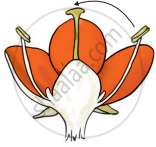
In which one of the following pollination is autogamous?
Autogamy can occur in a chasmogamous flower if ______.
What is hypohydrophily?
What is epihydrophily?
Complete the following table:
| Sr. | Type of pollination | Agent | Kind of flower | Examples |
| (i) | ______ | Wind | ______ | Maize |
| (ii) | Chiropterophily | ______ | Dull colour, with strong fragrance, abundant nectar | Adansonia |
| (iii) | Entamophily | Insects | ______ | Rose/Jasmine |
| (iv) | Ornithophily | ______ | Brightly coloured, large and showy. They secrete profuse, dilute n ectar | ______ |
Briefly discuss any two methods by which plants avoid self-pollination.
Bird pollinated flowers are usually ______.
Hydrophily (Hypo) is characterized by which of the following conditions?
Entomophily refers to pollination by which agency?
Which type of pollination involves the transfer of pollen between different plants of the same species?
Geitonogamy is characterized by which of the following?
