Advertisements
Advertisements
Question
Match the ordinates of the points given in Column A with the items mentioned in Column B.
| Column A | Column B |
| (a) (7, 0) | (i) The ordinate is double the abscissa. |
| (b) (11, 11) | (ii) The ordinate is zero. |
| (c) (4, 8) | (iii) The ordinate is equal to the abscissa. |
| (d) (6, 2) | (iv) The abscissa is double the ordinate. |
| (e) (0, 9) | (v) The abscissa is triple the ordinate. |
| (f) (6, 3) | (vi) The abscissa is zero. |
Advertisements
Solution
| Column A | Column B |
| (a) (7, 0) | (ii) The ordinate is zero. |
| (b) (11, 11) | (iii) The ordinate is equal to the abscissa. |
| (c) (4, 8) | (i) The ordinate is double the abscissa. |
| (d) (6, 2) | (v) The abscissa is triple the ordinate. |
| (e) (0, 9) | (vi) The abscissa is zero. |
| (f) (6, 3) | (iv) The abscissa is double the ordinate. |
Explanation:
(a) Clearly, the ordinate of the point (7, 0) is zero.
(b) In the point (11, 11), the ordinate is equal to the abscissa.
(c) In the point (4, 8), the ordinate is double of the abscissa.
(d) In the point (6, 2), the abscissa, i.e. x-coordinate is triple of the ordinate, i.e. y-coordinate.
(e) The abscissa of the point (0, 9) is zero.
(f) Clearly, the abscissa is double of the ordinate.
APPEARS IN
RELATED QUESTIONS
State whether True or False. Correct those are false.
The coordinates of the origin are (0, 0).
The process of fixing a point with the help of the coordinates is known as ______ of the point.
For the point (5, 2), the distance from the x-axis is ______ units.
In the point (2, 3), 3 denotes the y-coordinate.
The points (3, 5) and (5, 3) represent the same point.
The y-coordinate of any point lying on the x-axis will be zero.
From the given graph, choose the letters that indicate the location of the points given below.
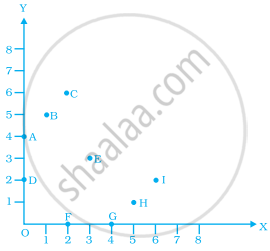
- (2, 0)
- (0, 4)
- (5, 1)
- (2, 6)
- (3, 3)
Write the y-coordinate (ordinate) of the given point.
(2, 7)
Observe the toothpick pattern given below:
(a) Imagine that this pattern continues. Complete the table to show the number of toothpicks in the first six terms.
| Pattern | 1 | 2 | 3 | 4 | 5 | 6 |
| Toothpicks | 4 | 13 |
(b) Make a graph by taking the pattern numbers on the horizontal axis and the number of toothpicks on the vertical axis. Make the horizontal axis from 0 to 10 and the vertical axis from 0 to 30.
(c) Use your graph to predict the number of toothpicks in patterns 7 and 8. Check your answers by actually drawing them.
(d) Would it make sense to join the points on this graph? Explain.
