Advertisements
Advertisements
प्रश्न
Match the ordinates of the points given in Column A with the items mentioned in Column B.
| Column A | Column B |
| (a) (7, 0) | (i) The ordinate is double the abscissa. |
| (b) (11, 11) | (ii) The ordinate is zero. |
| (c) (4, 8) | (iii) The ordinate is equal to the abscissa. |
| (d) (6, 2) | (iv) The abscissa is double the ordinate. |
| (e) (0, 9) | (v) The abscissa is triple the ordinate. |
| (f) (6, 3) | (vi) The abscissa is zero. |
Advertisements
उत्तर
| Column A | Column B |
| (a) (7, 0) | (ii) The ordinate is zero. |
| (b) (11, 11) | (iii) The ordinate is equal to the abscissa. |
| (c) (4, 8) | (i) The ordinate is double the abscissa. |
| (d) (6, 2) | (v) The abscissa is triple the ordinate. |
| (e) (0, 9) | (vi) The abscissa is zero. |
| (f) (6, 3) | (iv) The abscissa is double the ordinate. |
Explanation:
(a) Clearly, the ordinate of the point (7, 0) is zero.
(b) In the point (11, 11), the ordinate is equal to the abscissa.
(c) In the point (4, 8), the ordinate is double of the abscissa.
(d) In the point (6, 2), the abscissa, i.e. x-coordinate is triple of the ordinate, i.e. y-coordinate.
(e) The abscissa of the point (0, 9) is zero.
(f) Clearly, the abscissa is double of the ordinate.
APPEARS IN
संबंधित प्रश्न
State whether True or False. Correct those are false.
A point whose y coordinate is zero and x-coordinate is 5 will lie on y-axis.
Locate the points:
(1, 1), (1, 2), (1, 3), (1, 4)
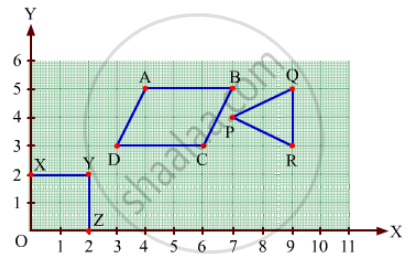
Write the coordinates of each of the vertices of each polygon in Fig. 27.9.
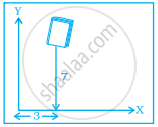
In the given figure the position of the book on the table may be given by ______.
A point in which the x-coordinate is zero and y-coordinate is non-zero will lie on the ______.
The distance of any point from the x-axis is called the x-coordinate.
Locate the points P(3, 4), Q(1, 0), R(0, 4), S(4, 1) on a graph sheet and write the coordinates of the point of intersection of line segments PQ and RS.
The table given below shows the temperatures recorded on a day at different times.
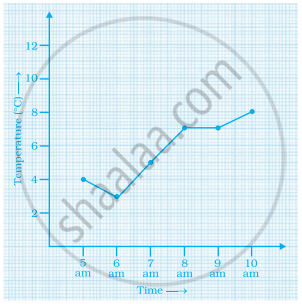
Observe the table and answer the following questions.
- What is the temperature at 8 am?
- At what time is the temperature 3°C?
- During which hour did the temperature fall?
- What is the change in temperature between 7 am and 10 am?
- During which hour was there a constant temperature?
Draw the line graph using suitable scale to show the annual gross profit of a company for a period of five years.
| Year | 1st | 2nd | 3rd | 4th | 5th |
| Gross Profit (in Rs) |
17,00,000 | 15,50,000 | 11,40,000 | 12,10,000 | 14,90,000 |
The points on the graph below represent the height and weight of the donkey, dog, crocodile, and ostrich shown in the drawing.
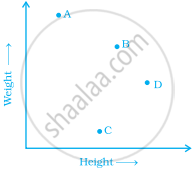
- What are the two variables represented in the graph?
- Which point represents each animals? Explain.
